The problem.
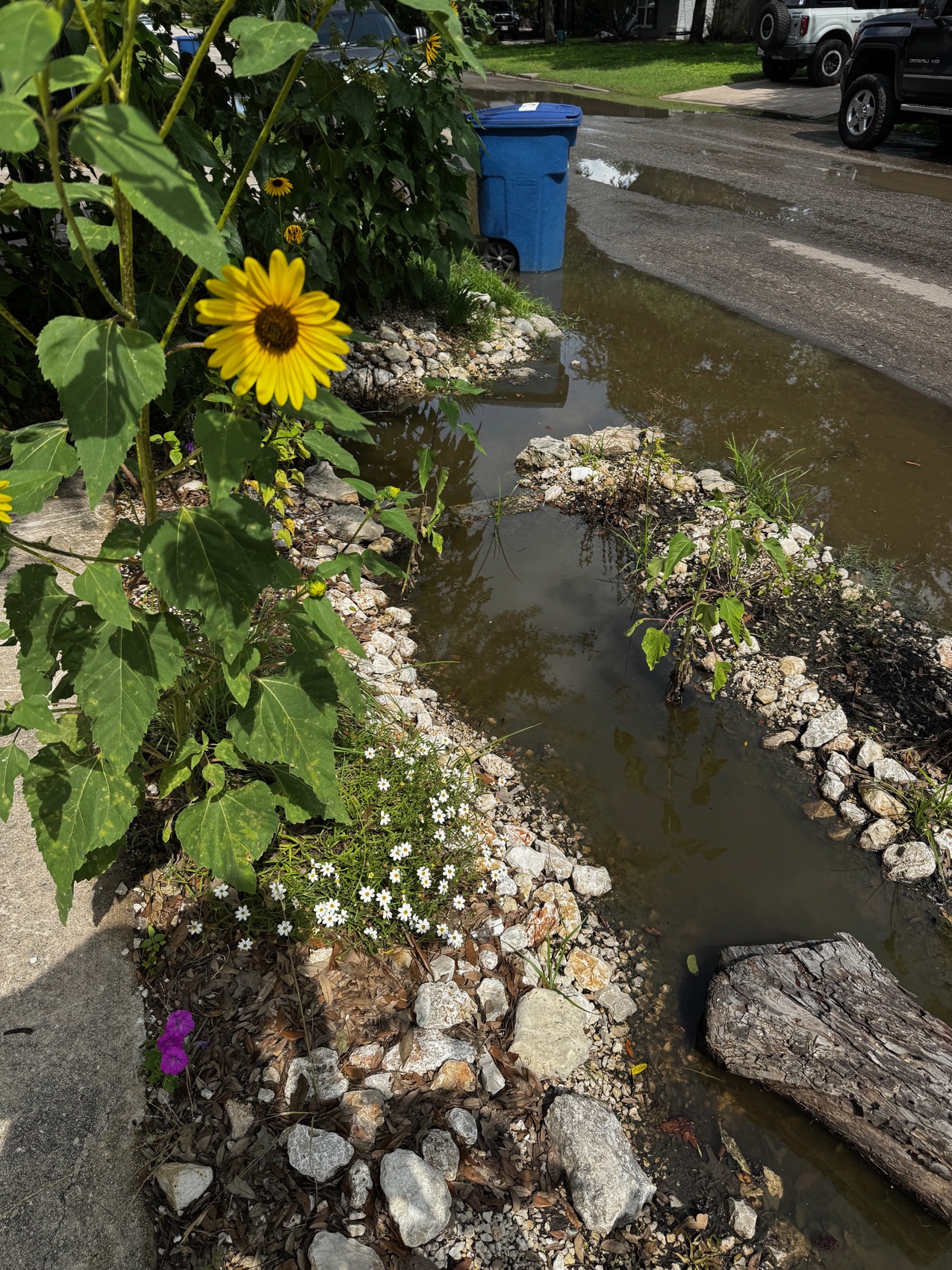
Every street in this city is engineered around one unexamined assumption: that rain is a problem to be removed as fast as possible. On a residential block in Alamo Heights, the assumption had failed in the usual way. Stormwater sheeted off the pavement, collected against the curb, and sat — stagnant, mosquito-breeding, going nowhere a person would want it to go. The standard remedy is a larger pipe: move the trouble downstream and make it someone else's flood. The owners here wanted no part of that, and brought us in to find a better way.

What they chose.
What they chose instead is older than the pipe and smarter, and we were glad to build it. A bioswale — a thirteen-foot planted channel, stone-lined, cut along the curb exactly where the water already wanted to travel. It does not resist the runoff; it receives it. The same two hundred-odd gallons an hour of street drainage that used to pool and turn now enter the swale, slow against the rock, and sink. A little over two thousand square feet of chronic standing water, resolved — not by removal, but by absorption.
What it does now.
The caliche — that hard, much-cursed Hill Country limestone soil everyone treats as a disease — turns out to be a perfectly good sponge if you give it a channel and a little time. The natives we planted along the bank do the rest: roots holding the soil, blooms feeding whatever flies. A sunflower the height of a man now stands where the standing water used to be, which is a more honest performance figure than anything a stormwater report has ever printed.
Observed figures from the installed swale — the absorption rate is field-observed, not a lab infiltration test. Performance varies with storm intensity and antecedent soil moisture.
First you size the storm you mean to catch. Rain volume on a contributing area:
Then size storage to hold it — ponding depth plus the open void in the soil and stone (gravel ≈ 40% void). Example, for illustration only:
to manage in the first flush
Illustrative — the sizing method, not this site's measurement. Each property is sized on its own catchment, slope, and soil during the Site Read.
The principle.
This is not innovation. It is memory. My people moved water this way for three centuries on the acequias that still run, quietly, beneath this city — slow it, spread it, let the ground drink, and hold to the old rule that water is a commons and not a nuisance. A residential bioswale is that exact logic, sized down to a single curb. Stop fighting the storm. Give it somewhere to go and it stops being a flood and starts, within a season, being a garden.
A swale like this only exists because an owner chooses it over the easy pipe. We read the ground, size the storm, and set the stone — but the decision to do right by the water is theirs, and we're grateful every time someone makes it.
- Site
- A residential street in Alamo Heights, San Antonio.
- Built
- 2025.
- The swale
- A 13-foot, stone-lined, curbside bioswale, planted with Hill Country natives.
- Performance
- Absorbs roughly 200 gallons an hour of street drainage; relieves about 2,000 sq ft of chronic standing water.
- Purpose
- Flood & stagnation mitigation — by absorption, not removal.
What it costs.
Infrastructure should be priced like infrastructure: transparently, by what drives the number. A bioswale isn't a flat menu item — its cost is set by length, the soil you're cutting, the stone and plants it takes, and how much water it has to move. So the price comes from the property, not from a brochure. Here is exactly how it's built up.
How a bioswale is priced
A $300 Site Read to start, credited in full. Quoted on the property. Often partly paid back by the city.