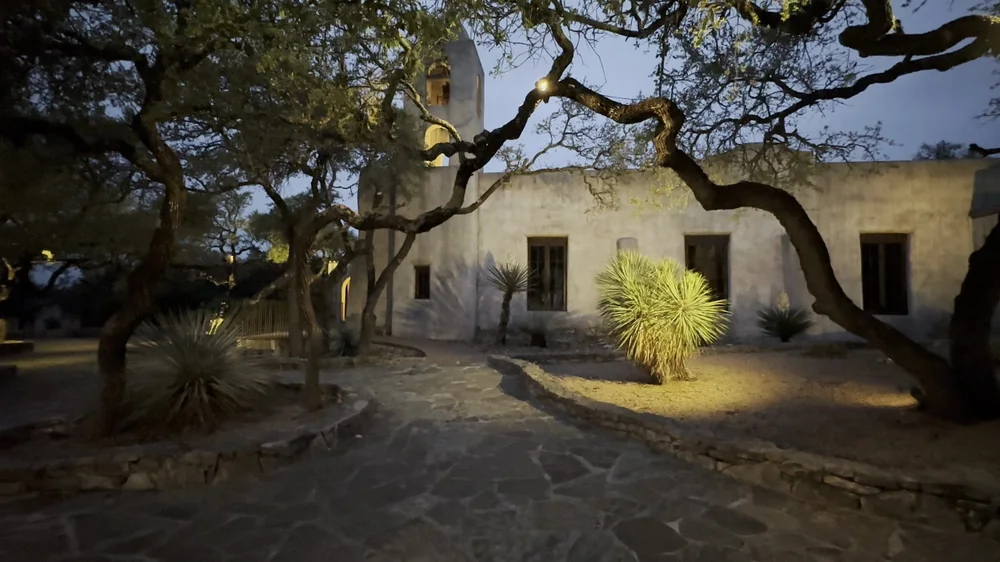
Walk the property for an hour before you draw on it. Most landscape failures begin in that missing hour — a drainage line cut perpendicular to a slope the designer never read, a fifty-year live oak removed because it stood where the sketch wanted a path, a planting palette specified for sun conditions that exist two hours of the day and never the eight that count. The land had been answering its own questions for a long time. Then a plan arrived that hadn't asked any.
The work that holds up — across decades, not seasons — starts from a different premise. The property already has a structure. Slope, drainage, soil profile, sun aspect, existing canopy: these together describe a system that has been running, in some version, for a long time. The job of the designer is to read that system carefully enough to add a layer of human use without breaking it.
At Noon we run five readings, in this order, on every property. They take sixty to ninety minutes on a typical half-acre to two-acre lot in San Antonio or the Hill Country. We don't draw anything until they're done.
One.Slope.
Slope is first because everything else depends on it. Water moves downhill, soil moves downhill, mulch moves downhill, and over time so do plants if their roots can't anchor against the grade. A landscape that ignores slope fails first at drainage, and then at planting — usually inside two summers.
We walk the property in the direction the water already moves — high to low, ridge to swale, the wet patches that haven't dried two days after the rain. An A-frame level for anything ambiguous. On complex sites a drone takes nadir photos and a processing run overnight returns an elevation model accurate to the inch — the kind that catches a four-inch grade change you'd miss by eye, and that decides whether a bioswale holds water or sheds it.
What slope tells us: where the bioswales go, where the catchment goes, where you can plant moisture-lovers, where you can't, and where the patio has to drop or rise to make sense of the rest of the design.
A landscape that ignores slope fails first at drainage, then at planting — usually inside two summers.
Two.Drainage.
Drainage is what slope and soil and impervious surface decide for you. After the slope read, we follow water to its end — standing puddles at the foundation, erosion stripes at the property line, the soggy spot under a downspout that grass never recovers from. Those are symptoms. The slope read tells the cause.
The Hill Country has a specific drainage problem: thin soil over caliche, with karst limestone underneath. Water hits the surface, runs because the soil can't absorb it fast enough, and either floods the property or exports the property's rainfall onto the neighbor's lot. A landscape design that doesn't account for this either creates the problem or fails to solve it.
What drainage tells us: whether the site needs a bioswale, a French drain, an aqueduct, a cistern, or some combination — and where each goes to actually catch the water before it leaves the property.
Three.Soil.
We probe. In San Antonio and the Hill Country there are typically three soils to find: blackland clay near the river bottoms, caliche-over-limestone on the uplands, and amended fill on newer subdivisions where developers brought in topsoil that is now running out. Each behaves differently with water. Each supports a different palette.
What we're after: depth before refusal — where the probe hits rock. Structure — clay clods, friable loam, or dust. Colour — organic content. Moisture — whether last week's rain is still in the profile, or already gone. pH matters less than people think for a native palette. Structure and depth matter more.
What soil tells us: how much we need to amend before planting, which native plants will actually root, and whether the irrigation plan needs to deliver water in short pulses or long deep soaks.
Four.Sun.
The sun read is really two readings.
The first is solar aspect — which slope faces which direction. South and west faces in central Texas are brutal in July; north and east faces are kind. Plants that thrive on a north-facing slope can die in a single afternoon on a west-facing one. We mark each face by aspect and slope angle, and we note the heat-island effect of nearby paving, roofs, and walls — the radiant load that adds to the solar load by midafternoon.
The second is canopy interaction — where existing trees throw shade, what time of day, and what time of year. Mature live oaks, post oaks, and cedar elms move enormous amounts of shade across a property between sunrise and sunset, and the path of that shade changes by season. A planting plan written from a Saturday morning visit may put a sun-loving plant in afternoon shade it can't tolerate.
What sun tells us: which microclimates exist inside the property, where the patio gets the late-summer sun bake, where the shade garden actually has enough light, and where outdoor solar can pull real wattage.
Five.Canopy.
The fifth read is everything already alive on the property that should stay. Mature trees first — most are worth keeping even if they're in awkward spots, because Hill Country trees that have survived thirty summers are pulling water and shade you cannot replace in less than a decade. We map every mature trunk, then look up at the canopy and ask: is this tree healthy enough to plan around for the next twenty years?
Beyond trees: existing native grasses, volunteer wildflowers, bird and pollinator activity. A property that's already supporting goldfinches, hummingbirds, or monarchs is telling us something about which plants want to live there. The fastest way to get a thriving native garden is to plant more of what already worked.
What canopy tells us: what to design around (not over), what to thin, what to amplify, and what an ecologically successful version of this property would look like at year five.
What comes after.
Only after these five do we sketch. The sketch is the synthesis: slope plus drainage plus soil plus sun plus canopy, layered over what the owner actually wants to do on the property — where they sit, where they grill, where the kids run, where the dog patrols. The plan is the answer to a single question: given what the land is already doing, how do we add a layer of human use that doesn't fight it?
A plan written this way takes longer up front. It holds up longer in the ground. Across a decade on the property, that trade isn't close.
The first site read on your property is free.
Drop your address →