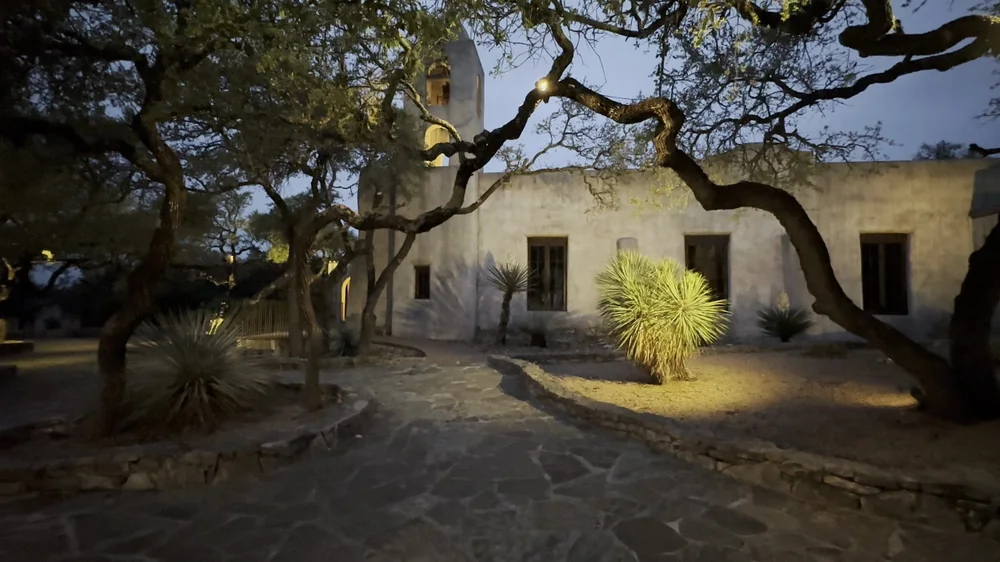
Compost is the answer to almost every soil question you can ask in central Texas. Caliche needs it to break and stay broken. Sandy fill needs it to hold water. Blackland clay needs it to loosen. Worn-out subdivision dirt needs it to live again. There is no soil in the region — none — that a steady supply of finished compost won't improve. Howard Garrett has been saying this for forty years and he is right.
The corollary nobody wants to admit: bagged compost from the box store is mostly not compost. It's ground pine bark with a little nitrogen added, usually too acidic for Hill Country soil and too thin to do real work. If you want compost that actually rebuilds a landscape, you make it. The good news is that making it well is straightforward, and once a system is running it produces more material per year than most properties can use.
Why compost beats fertilizer.
Synthetic fertilizer feeds the plant. Compost feeds the soil, and the soil feeds the plant — across years, through droughts, without burn risk, while building structure and water-holding capacity at the same time. A pound of NPK delivers its nutrients in a flush over a few weeks. A pound of compost releases nutrients slowly across two to three years, hosts the fungal and bacterial communities that mineralize nutrients already locked in the soil, and adds organic matter that improves the soil profile permanently.
The economics are honest too. A bag of synthetic fertilizer is cheap up front and pays nothing back. A working compost system runs on materials you'd otherwise pay to haul off — kitchen scraps, leaves, grass clippings, garden trimmings — and produces a soil amendment that, at landscape-grade volumes, would cost $50 to $80 a yard delivered. On a half-acre property with mature canopy, the math is not close.
The three-pile system.
The mistake most beginners make is keeping one pile. You add to it, it never finishes, half of it is fresh material on top of the part that's actually composting, and you can never use the bottom because the pile is still alive. The fix is three piles running on a rolling cycle.
Pile 1: Active. This is the pile you're currently building. Fresh kitchen scraps, fresh grass, fresh prunings, fresh manures all go here. You're layering browns and greens as you add. It gets hot fast — 130 to 160°F in the center within a week if it's built right. You don't take anything out of this pile.
Pile 2: Finishing. Once Pile 1 is full (typically a 3x3x3 foot cube or larger), you stop adding to it and start building Pile 1 again in a new bin. The full pile gets turned weekly into the finishing position. Temperatures fall from thermophilic to mesophilic over six to eight weeks. The pile shrinks by about half. Material starts looking like soil.
Pile 3: Ready. The finishing pile cures for another four to six weeks here without turning. Fungi colonize, ammonia smell disappears, and the result is a dark, crumbly, earthy-smelling finished compost you can use immediately on beds, tree pits, or seed-starting mix.
On most of our properties we build three-bin systems out of cedar 4x4 posts and removable hog-panel fronts. Each bin is roughly 4x4x4 feet. A property with mature canopy and a small kitchen will produce about three to five cubic yards of finished compost per year on this system — enough to top-dress beds, amend new plantings, and have material left over.
Browns and greens: the ratio that matters.
The number to remember is roughly 3 parts browns to 1 part greens by volume. Browns are carbon: dry leaves, shredded cardboard, wood chips, dead garden stalks, pine needles, straw, paper. Greens are nitrogen: kitchen scraps, fresh grass, coffee grounds, fresh prunings, well-aged manures, weeds pulled before they seed.
The ratio is by volume, not weight. People who try to follow a 30:1 carbon-to-nitrogen ratio by mass go insane and quit composting. The 3:1 visual rule is close enough — if the pile smells like ammonia, add browns; if it isn't heating up, add greens.
In central Texas the browns side of the equation is easy. The annual leaf drop from a single mature live oak supplies more browns than most kitchens generate in greens. We stockpile shredded leaves in a fourth holding bin each fall and feed them into Pile 1 across the year to balance whatever greens come in.
Moisture and turning.
A compost pile is alive, and like everything alive it needs water and air. The right moisture level is a wrung-out sponge — squeeze a handful and a drop or two should come out, no more. In central Texas this means watering the pile every three to five days through summer, less in spring and fall, almost never in winter. A dry pile doesn't compost. It mummifies and sits there for years.
Turning aerates the pile and redistributes hot and cool material. Once a week is the right cadence for an active pile. We use a long-handled compost fork — not a shovel. The fork punches into the pile, lifts and turns without compacting, and lets you fluff the lower layers up into the oxygen zone.
A correctly built pile turned weekly with adequate moisture will hold 130 to 150°F in the center for the first three to four weeks. You can feel the heat through the fork. That heat kills weed seeds, pathogens, and most fly larvae — it's the difference between finished compost and garbage.
Manures — only well-composted.
Chicken, horse, cow, rabbit, goat, sheep manures are all good additions to a compost pile, with two non-negotiable rules. First, only fully composted manures go on planting beds. Fresh manure burns roots, harbors pathogens, and often contains weed seeds the source animal ate and passed through intact. Add fresh manure to the active pile, let it run through the full hot cycle, and use only the finished product. Second, avoid manure from sources that may have been treated with persistent herbicides — aminopyralid and clopyralid pass through animals and stay biologically active in compost for years. Local small-farm and backyard-chicken sources are usually safe. Commercial hay-fed feedlot manure is a risk.
We never use cat, dog, or pig manure in any pile that will go on edible or ornamental beds. Pathogen risk is too high and the hot pile cycle is not reliable enough to sterilize it.
What never goes in.
Diseased plant material. Bermudagrass runners, nutgrass tubers, or any perennial weed root that can regenerate. Glossy printed paper and magazine inserts (ink and clay coatings). Coal or charcoal ash. Pressure-treated wood scraps. Citrus peels in volume (slow to break down, can suppress fungal activity). Walnut leaves or sawdust (allelopathic). Anything sprayed with persistent herbicide within the last year. Meat, dairy, and oily food scraps — these draw rodents and slow the pile down without contributing useful nutrients.
Leaf mold: the parallel pile.
Alongside the three-bin system we usually build a separate leaf-mold cage — a 4x4 foot wire enclosure where we dump whole leaves and let them sit for one to two years. Leaf mold is fungally decomposed (rather than bacterially decomposed like hot compost) and produces a different end product: lower in nitrogen, higher in fungal mass, with exceptional water-holding capacity. We use leaf mold on tree-planting holes, on shade beds, and as the moisture-retention component in seed-starting mix. Hot compost feeds plants. Leaf mold builds tilth. Both belong on the property.
What holds up.
A property running a three-pile system, a leaf-mold cage, and a steady mulch refresh — see the mulch article — closes the nutrient loop. Leaves fall, get mulched onto beds, eventually rake into the compost pile, come out as finished compost, get spread back onto beds. Almost nothing leaves the property as waste, almost nothing has to be trucked in as input. Soil organic matter climbs measurably year over year — from the 0.5 to 1 percent typical of stripped subdivision dirt toward the 4 to 6 percent that healthy native prairie soil ran before agriculture.
Building that loop takes a season to set up and a few hours a week to run. The payback is a landscape that gets healthier every year instead of declining every year. There is no shortcut to it and there is no substitute for it.
An old practice.
Building soil on purpose is older than Texas. The Coahuiltecan, the Spanish mission gardeners along the San Antonio River, and the German farmers who came later all worked composted manure, ash, leaf litter, and kitchen waste back into the ground because that was the only way to keep a garden producing on this caliche-and-limestone profile. The bag at the box store is the recent invention. A pile in the back corner of the property is the older, better one — we are not inventing anything new.