The physical resource is the property's own biomass. Walk a typical Bulverde or San Antonio half-acre at the end of October and inventory what's leaving in bags: fall leaves from the live oaks, cedar elms, and pecans; summer's worth of grass clippings; kitchen scraps from a household of four; spring prunings from crepe myrtles and rosemary; coffee grounds, eggshells, tea bags, vegetable trimmings. Add a chicken coop or two goats and add manure to the list. By volume this stream runs roughly two to four cubic yards per year on a half-acre, depending on tree cover and household size — somewhere between 2,000 and 5,000 pounds of organic material, all of it carbon, nitrogen, potassium, calcium, and trace minerals already on the property.
The same property, the same year, will pay to import mulch, compost, fertilizer, and bagged soil amendments in roughly the same volumes. The waste stream and the input stream are the same stream. They are flowing in opposite directions and crossing on the curb.
Ecology.
Leaves on a forest floor are how soil is built. Deciduous canopies have been depositing organic matter onto soil for roughly 400 million years, and the entire decomposer architecture of bacteria, fungi, springtails, isopods, millipedes, earthworms, and mycorrhizal hyphal networks evolved to process that input on site. A leaf that falls in October, on undisturbed soil, is incorporated by the following August. The carbon goes into stable soil organic matter; the nutrients cycle into the next year's growth; the canopy and the soil are a closed loop.
The decomposer community is layered and specialized. Surface litter is broken first by physical weathering and shredders — pillbugs, millipedes, springtails — reducing leaf area for the fungi that follow. White-rot and brown-rot fungi work the lignin and cellulose. Bacteria handle the easier sugars and proteins. Earthworms, where they exist, move the partly-processed material down into the mineral soil and concentrate nutrient in their castings. The whole cycle runs without input, without management, and without removal. The forest does not bag its leaves.
Bag that same leaf and send it to a Texas landfill and the physics inverts. Buried under anaerobic conditions, leaf carbon decomposes into methane — a greenhouse gas with roughly 28 times the 100-year warming potential of CO₂. The EPA's food-waste hierarchy and waste-emissions accounting both flag landfilled organics as one of the most carbon-costly fractions of the residential waste stream. Compost the same leaf on-site, in an aerobic pile, and the carbon goes mostly to CO₂ and to stable humus. Same leaf. Two opposite climate outcomes, decided by where you put it.
Economics.
Run the math on a half-acre. Annual outflow: two to four cubic yards of biomass bagged and removed, at curbside fee or as part of a fixed solid-waste rate. Annual inflow: $750 to $1,600 in purchased compost (see our piece on compost), $200 to $500 in mulch, $100 to $300 in lawn and bed fertilizer, plus the irrigation overage paid to SAWS because the soil has no organic matter to hold water. Call it $1,500 to $2,800 per year imported to replace what was exported.
The City of San Antonio Solid Waste Management Department spends real money handling the residential yard-waste stream — collection, transport, processing, landfill tipping. The city's organics processing capacity has grown; brush recycling exists; but most yard waste from most San Antonio properties still moves through the standard residential collection and is a cost to the city and a cost to the homeowner. Close the loop on the property and the two-direction transaction collapses into zero. The savings compound year over year as soil organic matter builds and water and fertilizer demand drop.
Craft.
Closed-loop technique is a small set of practiced moves, none difficult.
- Leaf mulching in place. Run a mower over fall leaves on the lawn. Pieces small enough to fall between blades feed the turf as they decompose. Texas A&M's Don't Bag It program documents 25-50% reduction in fertilizer demand from this single change.
- Leaf-corral cages. Wire-mesh cylinders under deciduous trees collect what the mower misses and convert it to leaf mold over a year — the single best soil amendment for shade beds.
- Chop-and-drop pruning. Spring prunings cut to fist-length pieces and dropped at the base of the parent plant decompose in place. Mulch, fertility, and labor savings in one move.
- Three-bin compost. Browns + greens cycling through active, curing, and finished stages. Covered in detail in compost from scratch in Texas.
- Chicken-tractor manure rotation. A movable coop on the lawn or in beds deposits manure where you want fertility next, on a schedule the soil can absorb.
- Greywater branched drain. Laundry, shower, and bathroom-sink water gravity-piped to mulched basins, watering fruit trees and ornamentals at no marginal cost. Legal under TCEQ 30 TAC §210 Subchapter F up to 400 gallons per day without a permit, with basic design rules.
- Kitchen-scrap composting. Counter pail to outdoor bin, daily. The shortest loop in the system.
Food.
The closed loop's food story is direct. Kitchen scraps go to the compost. Compost goes to the bed. The bed feeds the kitchen. The kitchen produces the next round of scraps. The loop is two months long for soft greens, three to six months for finished compost-to-tomato, and once running it does not stop.
Will Allen's Growing Power in Milwaukee — documented in The Good Food Revolution — operated for decades on this principle at urban scale, taking restaurant food waste, brewery spent grain, and yard waste in at the gate and shipping vegetables and aquaculture protein out the same gate. The San Antonio Food Bank's Mission Farm operates a smaller version of the same logic: on-site composting of farm and food-bank organics, feeding back into vegetable production for distribution. Both demonstrate at scale what a backyard can do at small scale. The numbers are different. The principle is the same: food waste is the next round of food, on a delay.
Architecture.
Closed-loop infrastructure is not afterthought, it is plan. Designed in from the start, the moves are invisible after install; bolted on later, they look like a hobby.
The standard kit, scaled to property:
- Compost yard between the back door and the kitchen bed, sized for three bins on a half-acre, screened with a fast hedge or a slat fence, sited where water drains through and downhill of nothing valuable.
- Greywater branched drain stubbed out of the laundry and bathroom walls at construction or remodel, delivering to mulched basins around fruit trees. Retrofit is possible; designed-in is cleaner.
- Leaf-corral cages under deciduous trees, positioned where the autumn canopy actually drops, sized to the tree's annual leaf output.
- Chicken-tractor lane if there are birds — a strip of lawn or bed wide enough to rotate the coop through, on a schedule.
- Counter pail / chute in the kitchen — the loop dies at the kitchen interface if scraps are inconvenient to capture.
The Hill Country vernacular farmhouse — German-Texan limestone, 1840s onward — included most of this as standard: cistern at the corner of the porch, chicken yard off the back, kitchen garden ten paces from the door, manure pile downhill of the barn. The architecture knew. We are re-learning what was lost when we stopped building this way.
Culture.
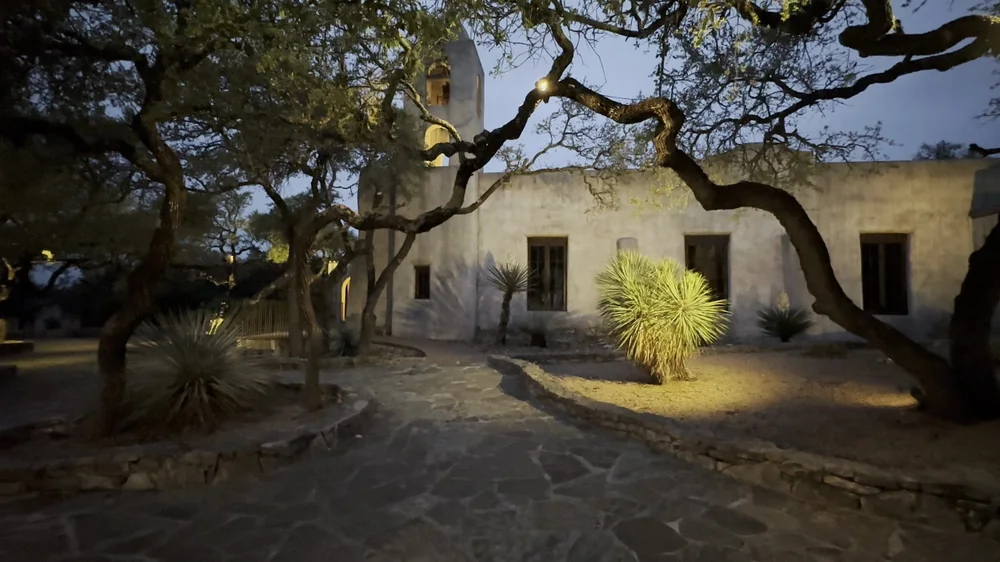
Pre-industrial agriculture had no concept of "organic waste" because nothing was wasted. The mission farms below San Antonio, documented by the National Park Service, cycled animal manure from the corrals back to the acequia-fed fields as standard practice — corn straw, bean residue, squash vines, hide and bone scrap all returning to the soil. South Texas ranch traditions through the nineteenth century operated on the same closed logic out of necessity: imported inputs were expensive, on-site inputs were free, and the soil stayed alive because of it.
The Coahuiltecan-speaking peoples whose lands included Bexar County, documented in William Foster's expedition records and in the archaeological soil-chemistry work done at South Texas mission and pre-mission sites, built up local fertility through long-term refuse middens — bone, shell, plant residue layered across generations of use. These middens are still detectable in soil-phosphorus signatures centuries after abandonment. The pattern is not unique to the region; it is universal across pre-industrial settlement. People who stayed in one place built soil in that place. People who moved across landscapes built it more diffusely. Either way, organic matter cycled.
The mid-twentieth century cultural shift to single-use disposal — bagged groceries, bagged yard waste, bagged fertilizer, the whole linear-economy frame — broke the loop within two generations. It was sold as modern and easy. It is, on inspection, neither: it is expensive at both ends and ecologically destructive in the middle.
What is recovering now — urban farming, regenerative agriculture, neighborhood compost coops, the San Antonio Food Bank's Mission Farm, school garden programs across San Antonio ISD, the regional regenerative-ag conversation — is the old practice walking back through the door wearing different clothes. The frame has changed. The math is the same math the missions ran.
See also: compost feeds the soil, mulch choices for the Hill Country, and the mission garden palette.