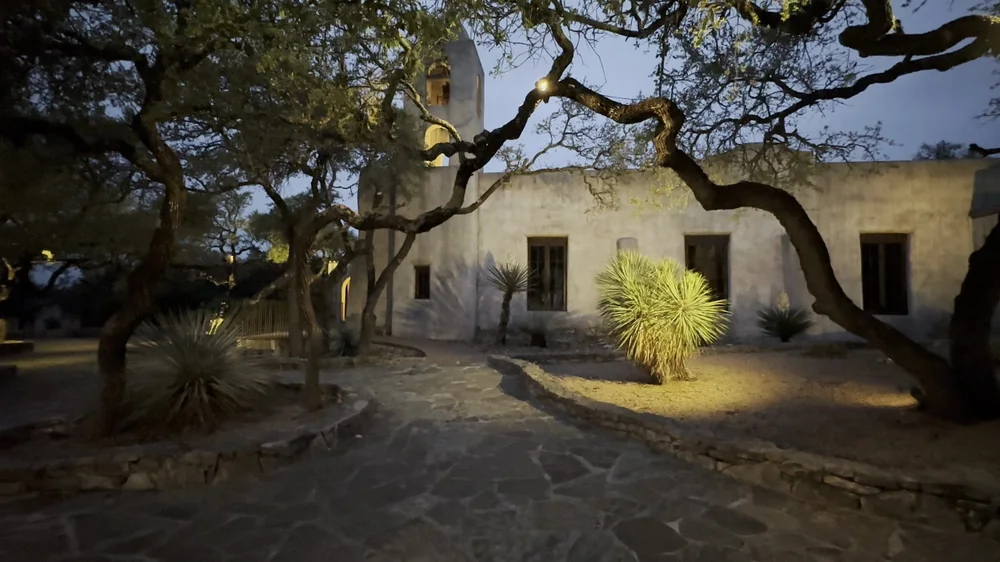
The split between "ornamental" and "edible" is a 20th-century invention. The Mission gardens that anchor San Antonio's founding — Mission San José, Mission Concepción, the acequia-irrigated huertas that fed the city for two centuries — were the same garden. Pomegranate next to roses. Fig next to mountain laurel. Prickly pear as fence and food and fruit at once. The split happened later, when nurseries decided ornamental and edible were separate aisles.
We don't run that split. Every Noon property has a designed food layer in it, sized to the household and integrated into the planting plan so it reads as part of the landscape, not as a vegetable patch bolted on to the side. This is the palette we use.
Why edibles in the landscape.
Three reasons that compound. The food line. A productive backyard fig or persimmon pays back decades of low-input fruit. Biodiversity. Fruit trees, herbs, and pollinator-attracting vegetables broaden the food web on the property — more bees, more birds, more beneficial insects to keep pest pressure honest. Climate fit. The edibles that work here are the ones that were already growing in semi-arid regions for centuries — Mediterranean, Mexican, and Mission-lineage. They want this climate. The Pacific Northwest blueberry catalog does not apply to San Antonio.
Trees first — the permanent layer.
The food trees on this list are also legitimate landscape trees. Plant them where you'd plant a small flowering tree.
Texas persimmon (Diospyros texana) — full sun, very drought tolerant, 10–20 ft. Native to the Edwards Plateau. Smooth gray bark, small dark green leaves, dioecious (you need a male and a female for fruit, or a self-fertile cultivar). Female trees produce small black fruit in late summer — sweet when fully ripe, astringent if eaten early. A staple indigenous food.
Asian persimmon (Diospyros kaki) — full sun, moderate water, 15–25 ft. Not native, but well adapted. Fuyu (non-astringent, eat firm) and Hachiya (astringent, eat fully soft) are the standard varieties. Spectacular fall color. Fruit holds on the tree after leaf drop — looks like ornaments.
Pomegranate (Punica granatum) — full sun, drought tolerant, 8–15 ft as a tree, 6–8 ft as a shrub. Mediterranean lineage, present in San Antonio for 300 years via the Mission gardens. Orange flowers in spring, fruit ripening in October. Wonderful and Salavatski are the production varieties.
Fig (Ficus carica) — full sun, moderate water once established, 10–15 ft. Brown Turkey, Celeste, and Texas Everbearing are the reliable San Antonio varieties. Two crops in a good year — a small breba crop in early summer on last year's wood, then the main crop in late summer. Birds will take half if you don't net.
Shrubs — prickly pear, pomegranate, and the line.
Prickly pear (Opuntia ficus-indica) for the spineless production variety; (Opuntia engelmannii) for the native landscape variety. Both produce edible pads (nopales) and fruit (tunas). The native species is drought-bulletproof and works as fence, food, and wildlife forage at once. The spineless cultivar is easier to harvest but less tough. Prickly pear is the keystone Mission-garden edible.
Pomegranate as shrub — counted again because it works either way. Hedged at 6 ft, it's both a productive food shrub and a defensible boundary plant. Spring orange flowers visible from across the property.
Perennial herbs — the Mediterranean stack.
All of these are full sun, drought tolerant, evergreen or semi-evergreen, and fit anywhere in a landscape that wants Mediterranean texture. They earn ornamental slots, not just kitchen slots.
Rosemary (Salvia rosmarinus) — 3–4 ft mounding shrub. Blue flowers in winter when little else blooms. Tuscan Blue is upright, Prostratus is a 12-in groundcover variety for spilling over walls. Sharp drainage required — root rot in wet clay is the only thing that kills it.
Greek oregano (Origanum vulgare subsp. hirtum) — 12–18 in. The actual culinary oregano. Spreads gently. Pinch flower spikes if you want stronger leaf flavor.
Thyme (Thymus vulgaris) and creeping thyme (Thymus serpyllum) — 6–12 in. Wants the same rocky, dry conditions as rosemary. Pink flowers on the creeping type cover the ground in late spring.
Garden sage (Salvia officinalis) — 18–24 in. Gray-green leaves, blue flowers. Reliable here if the drainage is right. Berggarten is the broad-leaf production variety; Tricolor and Purpurea are ornamental.
Mint (Mentha spp.) — only ever in containers. In the ground, mint becomes a permanent property feature you didn't ask for. Spearmint and peppermint both grow vigorously in pots in dappled shade.
Mexican mint marigold (Tagetes lucida) — 18–24 in. The local tarragon substitute — true French tarragon will not survive San Antonio summers. Yellow flowers in fall. Full sun.
Annual veg — the two-season calendar.
San Antonio has two growing seasons, not one. Trying to push a single Northern-style summer vegetable garden through July is how most new gardeners fail here. Run the calendar the climate actually has.
Cool season — October through April. Direct-sow or transplant in October: lettuce, spinach, kale, chard, arugula, mustards, cilantro, dill, peas, carrots, beets, radishes, broccoli, cauliflower, cabbage, onions (short-day varieties — 1015s and Granex), garlic. This is the easier season. Pest pressure is lower, water demand is lower, and most things bolt before you can harvest enough.
Warm season, spring window — March through June. Transplant in mid-March: tomatoes (Celebrity, Roma, cherry varieties), peppers (jalapeño, serrano, bell), basil, eggplant. Direct-sow: green beans, cucumbers, summer squash, melons. The window closes in late June when nights stay above 75°F and tomatoes stop setting fruit.
Warm season, fall window — July through November. Yes, transplant tomatoes in July. They look miserable for three weeks, then they take off as nights cool. The fall crop usually outproduces the spring crop. Same with peppers and beans. Direct-sow okra, southern peas, sweet potatoes, and pumpkins for fall.
This calendar is consistent with Texas A&M AgriLife south-central Texas planting guides and our own results across San Antonio properties.
Where this sits in the landscape.
The Noon stack: anchor trees and small flowering trees from the native palette, with persimmons, pomegranates, and figs slotted in among them as small-tree equivalents. Shrub layer mixes cenizo and agarita with prickly pear and pomegranate hedge. Perennial layer mixes Salvia greggii and gulf muhly with the Mediterranean herb stack — rosemary reads as cenizo at a glance, and earns its slot as both texture and food. Annual veg lives in a defined zone with deer fence if needed, sized to the household.
For perennial selection by exposure inside this stack, see drought-tolerant perennials by exposure. For how we read the slots before placing any of this, see reading the land. For the historical lineage of the integrated food-and-ornamental garden in San Antonio, see the Mission garden palette.