NoonThe Source
NOON SYSTEMS · PBC
SAN ANTONIO, TEXAS
Palette & Planting
NATIVE PALETTE · LIVE
Palette & Planting · Native Palette

The native palette for San Antonio & the Hill Country.

The plants that actually hold up here, organized by layer. Anchor trees, small flowering trees, shrubs, perennials, groundcovers — with what each one does in a real residential landscape, and the plants we don't use and why.

By Dorian Dégagé · Noon Systems Corporation · San Antonio, TX · ~9 min read

A landscape only works if the plants in it want to be there. San Antonio sits at the eastern edge of the Edwards Plateau, on the boundary between blackland prairie and Hill Country limestone. Summers run 100°F for weeks. Rainfall is bimodal — spring and fall — with long dry stretches between. The plants that evolved here already solved this. Most of the plants in big-box garden centers did not.

This is the palette Noon plants. It's organized by layer, the way a designed landscape gets built: anchor trees first, then small flowering trees, then shrubs, then perennials, then groundcovers. Every species below is verified against the Lady Bird Johnson Wildflower Center native range data and Texas A&M AgriLife recommendations for our zone.

Why native.

Three reasons. Water — a mature native landscape runs on rainfall most years. A mature ornamental landscape from the standard nursery catalog runs on irrigation, and the irrigation bill grows every year. Pollinators — native plants co-evolved with native bees, butterflies, and hummingbirds. They feed the system the property already belongs to. Failure rate — natives planted into the right slot fail less. The fight you're not having with the wrong plant in the wrong place pays for the whole palette over a decade.

None of this is purity. We use a small set of well-behaved non-natives where they earn their slot (see the edible landscape article for that list). The rest of the property is native because native works.

Anchor trees — the structure.

Anchor trees do three jobs: shade, structure, and time. They're the longest-lived element on the property and the first thing we map on a site read. A property with the right anchor trees in the right spots is set up for a century. A property without them is starting from a deficit no perennial palette can close.

Live oak (Quercus fusiformis / Quercus virginiana) — full sun, drought tolerant once established, 40–60 ft tall, 60–80 ft wide. The defining tree of central Texas. Casts dense shade, holds leaves through winter. Oak wilt is real — prune only in the dormant heat of summer or deep cold of winter and paint cuts immediately.

Cedar elm (Ulmus crassifolia) — full sun, drought tolerant, 50–70 ft tall. Faster than live oak, deciduous, beautiful fall color in a region that mostly doesn't have one. Handles caliche soil better than most large trees.

Texas red oak (Quercus buckleyi) — full sun, drought tolerant, 30–50 ft tall. Smaller anchor with real fall color — deep red in November. Native to the Edwards Plateau. Same oak wilt pruning rules as live oak.

Escarpment black cherry (Prunus serotina var. eximia) — full sun to part shade, 30–40 ft tall. The Hill Country variant of black cherry, drought tolerant where the species back east is not. White flower racemes in spring, fruit for birds in summer.

Anaqua (Ehretia anacua) — full sun, drought tolerant, 25–45 ft tall. Evergreen in mild winters, sandpaper-textured leaves, fragrant white flower clusters in spring. Underused. Excellent west-side anchor where summer afternoon sun is brutal.

Small flowering trees — the color layer.

These sit under the anchor canopy or stand alone at 15–25 ft. They carry the spring bloom that the big anchors don't.

Texas mountain laurel (Dermatophyllum secundiflorum) — full sun, very drought tolerant, 10–20 ft tall, evergreen. Purple flower clusters in March smell like grape soda. Slow grower, worth the wait. Seeds are toxic — don't plant where small children graze.

Mexican plum (Prunus mexicana) — full sun to part shade, drought tolerant, 15–25 ft tall. White flowers in February before the leaves — the first bloom of the year here. Small edible plums for wildlife.

Eastern redbud (Cercis canadensis var. texensis) — sun to part shade, drought tolerant, 15–25 ft tall. The Texas variety has thicker, glossier leaves than the eastern type and handles our heat. Magenta flowers in early spring on bare branches.

Anacacho orchid tree (Bauhinia lunarioides) — full sun, very drought tolerant, 10–15 ft tall. White orchid-like flowers off and on from spring through fall. Native to the limestone canyons west of here, perfectly adapted to caliche.

Shrubs — the middle structure.

Autumn sage (Salvia greggii) — full sun to part sun, drought tolerant, 2–3 ft tall. Blooms spring through fall, red being the standard but cultivars come in coral, pink, white, and purple. Hummingbird magnet. Shear hard in late winter.

Cenizo (Leucophyllum frutescens) — full sun, very drought tolerant, 4–6 ft tall. Silver foliage, purple flowers that bloom in response to humidity — usually after a rain. The classic Hill Country shrub. Hates wet feet.

Flame acanthus (Anisacanthus quadrifidus var. wrightii) — full sun, drought tolerant, 3–4 ft tall. Orange tubular flowers from summer into fall when most other things have quit. Hummingbird and butterfly plant. Dies back in hard winters and returns from the root.

Agarita (Mahonia trifoliolata) — sun to part shade, very drought tolerant, 3–6 ft tall, evergreen. Holly-like spiny leaves, yellow flowers in February, red berries in May for birds (and people who make agarita jelly). Wildlife cover.

Kidneywood (Eysenhardtia texana) — full sun, very drought tolerant, 6–10 ft tall. Fragrant white flower spikes off and on through the warm months. Larval host for several butterflies. Underused, deserves a slot.

Perennials — the ground-level color.

Salvia greggii — counted again because the perennial-sized cultivars belong in the perennial layer at 18–24 in.

Gulf muhly (Muhlenbergia capillaris) — full sun, drought tolerant, 2–3 ft tall, pink cloud of seedheads in October. Plant in groups of five or more — one alone looks lonely; five looks intentional.

Bushy bluestem (Andropogon glomeratus) — full sun, handles wet better than most natives, 3–5 ft tall. White fluffy seedheads in fall and winter that catch low sun. Good around bioswales.

Mexican feathergrass (Nassella tenuissima) — full sun, very drought tolerant, 18–24 in. Wispy, movement in any breeze. Reseeds — manage it or it spreads. Worth managing.

Lindheimer muhly (Muhlenbergia lindheimeri) — full sun, drought tolerant, 3–5 ft tall. The big-scale muhly. Silver-white seedhead plumes in fall. Hill Country native, perfectly at home on caliche.

Groundcovers — the finishing layer.

Frogfruit (Phyla nodiflora) — sun to part shade, low water once established. Spreads flat by runners, takes light foot traffic, blooms small white flowers continuously. The native lawn alternative — not a lawn, but coverage that mows.

Silver ponyfoot (Dichondra argentea) — full sun, very drought tolerant. Silver mat-forming groundcover, beautiful spilling over a wall or boulder. Won't take traffic.

Prairie verbena (Glandularia bipinnatifida) — full sun, drought tolerant. Purple flowers nearly year-round in mild winters. Reseeds gently. Mixes well with frogfruit in transition zones.

What we don't plant — and why.

Crepe myrtle — Asian, not native. Fine plant, but the slot is better filled by Texas mountain laurel, Mexican plum, or anacacho orchid tree. Plus crape myrtle bark scale has become a maintenance burden across south Texas.

Nandina (Nandina domestica) — invasive in Texas. Berries are toxic to cedar waxwings and other birds. We pull it when we find it.

Mondo grass — needs more water than it pays back, and frogfruit or sedge does the same job on rainfall.

Asian jasmine — fine groundcover, but it harbors rats in dense plantings near houses and contributes nothing to the local food web. We use native groundcovers instead.

Bradford pear — brittle, short-lived, invasive in central Texas, and the flowers stink. Hard no.

Chinaberry, chinese tallow, ligustrum — all invasive. We remove them when we find them.

For exposure-specific perennial selection inside this palette, see drought-tolerant perennials by exposure.

The older palette.

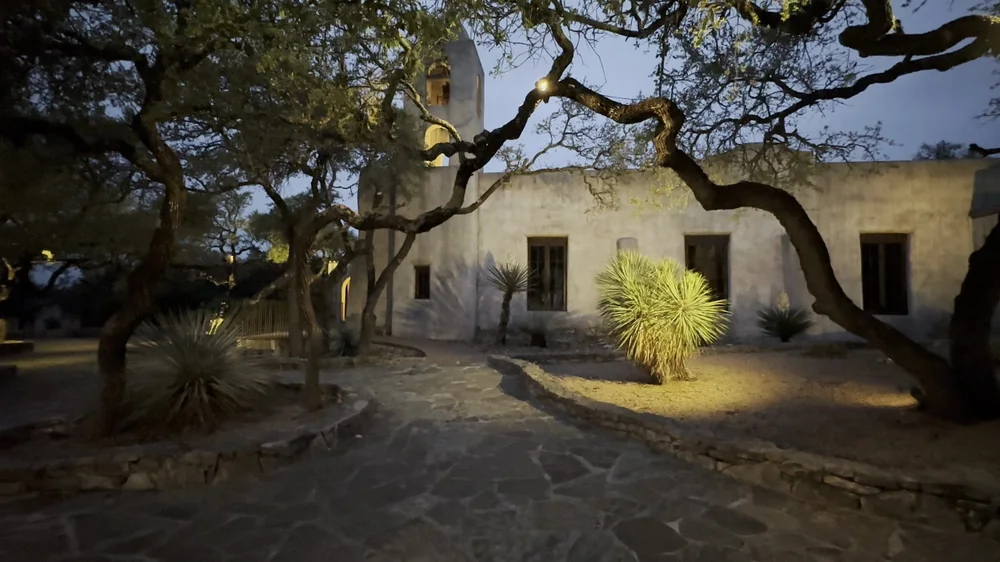
None of these plants are new. Live oak, mesquite, prickly pear, agarita, yucca, mountain laurel — the Coahuiltecan bands of South Texas, the mission gardeners of San Antonio, and the Tonkawa and Lipan Apache further west all knew this catalog as food, fiber, dye, fuel, and shade long before it was an ornamental list. We are not introducing the palette. We are reintroducing the property to it.

A mature native landscape runs on rainfall most years. The fight you're not having with the wrong plant in the wrong place pays for the whole palette over a decade.

Sources

  1. Lady Bird Johnson Wildflower Center · Native Plant Database — species range, soil, and water requirements.
  2. Native Plant Society of Texas · Regional chapter guides and recommended-species lists.
  3. Texas A&M AgriLife Extension · Aggie Horticulture — Earth-Kind® plant trials and South Texas landscape lists.
  4. Texas Parks & Wildlife · Texas ecoregions — Edwards Plateau and South Texas Plains.
  5. Daniel E. Moerman · Native American Ethnobotany · Timber Press · 1998.
  6. Texas State Historical Association · Handbook of Texas — Coahuiltecan, Lipan Apache, Tonkawa entries.

Where the published record is thin or varies by source, we say so in the body. Indigenous plant knowledge described here is drawn from documented ethnobotanical record and is presented as historical/educational, not as medical advice.

Common questions.

What about non-native plants that work well in San Antonio?

A handful earn their slot. Pomegranate, fig, and rosemary are Mediterranean but behave like natives here — drought tolerant, low input, and useful. We use them in edible zones. We avoid the rest of the imported ornamental catalog because the natives do the same job with a quarter of the water and feed the local pollinators on top.

Are crepe myrtles bad?

Not bad, just not native. Crepe myrtle (Lagerstroemia indica) is from Asia. It grows fine here and is everywhere. We prefer Texas mountain laurel, Mexican plum, and anacacho orchid tree for the same small-flowering-tree slot because they support local pollinators and birds, and they don't need crape myrtle bark scale management.

Do native plants need irrigation?

For the first one to two summers, yes — deep weekly soaks while roots establish. After that, most of this palette runs on rainfall alone in a typical year. Perennials and groundcovers may want supplemental water in extended drought; established anchor trees almost never do.

Where do I source native plants in San Antonio?

Rainbow Gardens, The Garden Center on Bandera, and the Medina Garden Nursery in Medina carry most of this palette. The Lady Bird Johnson Wildflower Center spring and fall plant sales are excellent for harder-to-find species like cedar sage and plateau wood violet.