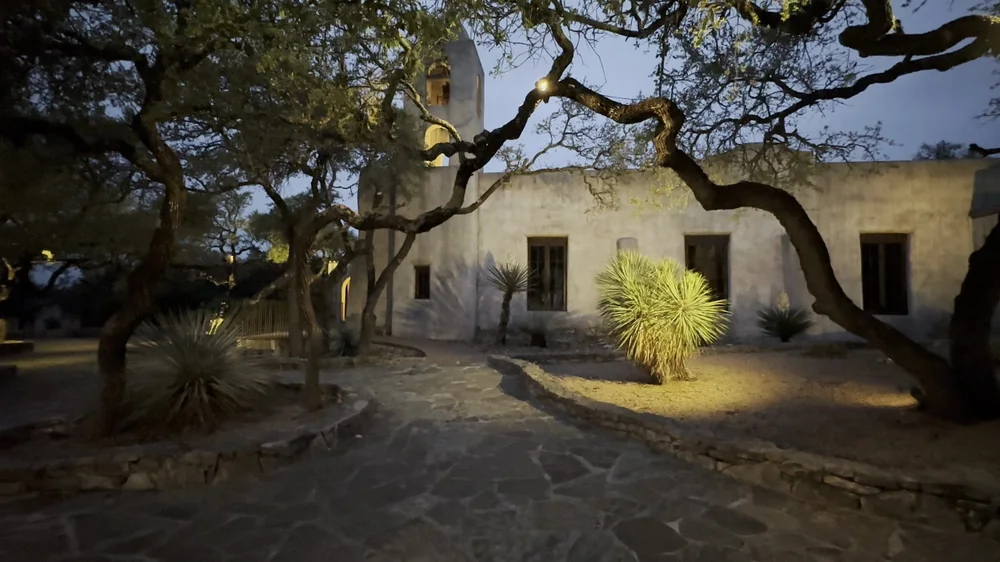
Most landscape blogs are search-bait. Three hundred words of generic "Top 10 Native Plants for Texas," written to capture a Google query and pipe a reader to a contact form. The work itself never appears on the page.
That isn't what this is.
The Noon Source is a working library. Each entry is one of three things: a methodology piece (how we read a site), a materials piece (what we install and why), or a stewardship piece (what a finished install asks of you across seasons). The standard for an entry is simple — if it doesn't reflect a real decision we make on a real property, it doesn't get published.
Why a landscape studio publishes.
Three reasons.
First — the work is hard to describe. A bioswale is not a feature. A water-budget is not a sales tool. A native palette is not a vibe. These are systems with constraints, costs, payoff curves, and failure modes. If we don't write them down, the only people who understand them are the ones who already hired us — and that limits how much good the practice can do.
Second — the alternative is misinformation. "Drought-tolerant landscape" is the most over-used phrase in Texas residential design, and most of what it describes is neither drought-tolerant nor a landscape. Owners pay for plants that die in the second summer because nobody handed them ground truth. This page is one attempt at handing back ground truth.
Third — Public Benefit means public benefit. Noon Systems is a Texas Public Benefit Corporation. The legal structure obligates us to operate for measurable public good alongside profit. A working library is one way to do that. The same information that shows up in a paid proposal shows up here — for free — for anyone who wants to read it.
What lives in The Source.
Six content categories, in rough order of how often we publish:
- Resource Culture — eight anchored entries, each starting with a physical resource (compost, rainwater, organic waste, shade canopy, roof catchment, polyculture, subsurface, Edwards Limestone) and tracing it outward through ecology, economics, craft, food, architecture, and culture. This is the methodological spine of the library. The principles: Feed the soil, not the trees · Water is a traveler, not a utility · Waste is a resource in the wrong place · Shade is infrastructure · Every property is a watershed · Diversity creates resilience · Healthy landscapes are built from the ground up · Local resources create local culture.
- Methodology — how we read a property. Slope, drainage, soil, sun, existing canopy, water budget. The five readings we do before any line gets drawn.
- Palette + Materials — the plants, stones, mulches, edging, and lighting we reach for first, and the constraints that put them in our toolbox in the first place.
- Systems — bioswales, aqueducts, cisterns, irrigation, outdoor power, lighting. Each system written up as it actually runs on a property.
- Local Culture & Indigenous Knowledge — yucca for soap and fiber. Mesquite for flour. Prickly pear for syrup and dye. Mission acequias for water. The ten thousand years of South Texas plant-use that consumer life replaced with bar codes. These entries cross over with the practical ones on purpose.
- Stewardship — what a finished install asks of you across seasons. The first-year, third-year, fifth-year shape of a Hill Country landscape that holds up.
The Resource Culture method.
Every Resource Culture article follows one discipline: start from a physical, named, quantified resource — never from ideology. Then trace that resource outward through six domains in order: ecology, economics, craft, food, architecture, culture. The capstone principle is the last line, earned by what came before. The eight anchor entries are the spine of the library; every other entry should be locatable on the map they draw.
Why the cultural entries.
A native palette is not a planting list. It's a record of what this place can provide a person if they know how to ask. The plants in our Hill Country installs were food, medicine, fiber, dye, fuel, ceremony, and music long before they were ornamentals. The acequia we draw inspiration from is not just clever drainage — it is a 300-year-old water-sharing institution that the Spanish built on a Coahuiltecan and Apache foundation that goes back millennia.
Most contemporary landscaping erases that knowledge. A yard becomes a furniture set. A plant becomes a SKU. The owner buys cleaning products at the store while a yucca plant ten feet from the porch contains the soap their great-grandmother washed clothes with. That gap is what The Source is for.
We do not romanticize indigenous knowledge or claim authority over it. We write what is documented, credit who documented it, and connect each piece to a plant or system that's already on a Hill Country property. The point is to put resource literacy back within reach — so a landscape becomes a working ecology again, not a backdrop for consumption.
The three layers rule.
Every entry connects three layers — that's the discipline:
- Practical use — what you actually do with this on a property. The field application.
- Ecological function — how it fits the larger system. Soil, water, pollinators, energy, succession.
- Cultural or historical meaning — what this plant, system, or material has meant in San Antonio, the Hill Country, the Edwards Plateau. Who used it, how, and where the record comes from.
A reader who reads three entries should sense a fabric, not a list. Soil shapes water, water shapes plants, plants shape culture, culture shapes the way the porch sounds at dusk. The Source tries to write that way.
The standards we hold ourselves to.
Every Noon Source article carries a fixed structure so the library reads as a working field manual instead of a collection of posts:
- A clear title and a short intro that names the problem.
- Field application — how to actually use this on a Hill Country property.
- Local relevance — San Antonio, the Texas Hill Country, the Edwards Plateau. Names of places, soils, plants that are actually here.
- A Resource Intelligence Principle — one line that captures what the entry teaches about belonging to a place.
- Sources — every factual claim cited to a published, verifiable reference. Texas A&M AgriLife. Lady Bird Johnson Wildflower Center. NPS San Antonio Missions. Daniel Moerman's Native American Ethnobotany. Edwards Aquifer Authority. SAWS. The Handbook of Texas. When the record is thin, we say so.
- A CTA back to a Noon site read or consultation.
What we do not claim.
The Noon Source is a field manual, not a medical guide, a religious authority, or a representative of indigenous communities. Three discipline lines we hold:
- No medical advice. Where we describe traditional or historical medicinal uses of plants, we frame them as documented historical record — what published ethnobotanies say was used and by whom. We never prescribe.
- No spiritual or epigenetic claims. We do not claim a plant aligns your nervous system, your epigenetics, or your soul. We describe what plants did, ecologically and culturally, and let the reader feel what they feel.
- No cultural ownership. Indigenous plant knowledge belongs to indigenous communities. We cite published ethnobotanical records, credit the documented traditions, and direct readers to indigenous-led sources where appropriate. We do not perform ceremony, claim authority, or speak for any tribe.
What doesn't live here.
Pricing. Specifications for individual client jobs. Plant lists that haven't been tested in our installs. Marketing photography without context. The library is not the same surface as the studio — and the studio is not the same surface as the library.
How to use it.
Read what's here. If a piece changes what you'd do on your own property, that's the right outcome. If a piece makes you want to talk to us about a property, the site read is on the home page. There is no paywall, no email gate, and no script tracking which posts you read.
The Noon Source is just the work, written down.