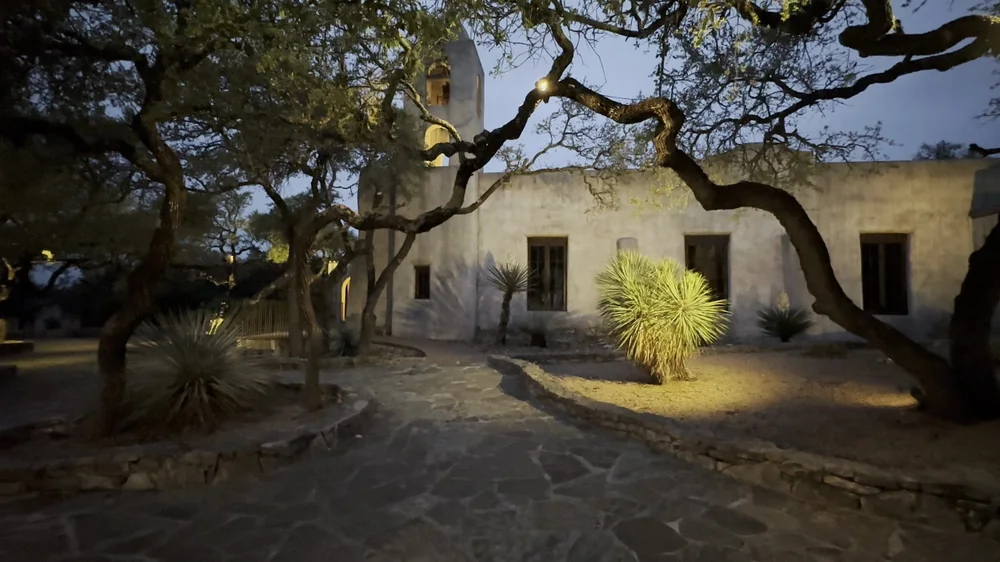
Edwards Limestone is the bedrock under all of it. The Cretaceous formation geologists call the Edwards Group runs about three hundred feet thick where it surfaces in Bexar County, and you can read it off the land without a map. It's the pale gray rock in every roadcut on 281 north of 1604. It's the bottom of every Hill Country creek where the water has cut down far enough. It's the rubble in the courses of the 1718 mission they later called the Alamo, and the cut block at Concepción, San José, San Juan, and Espada. It's the River Walk wall, the dry-stack fence between two ranches outside Comfort, the chimney on a Sunday house in Fredericksburg, the veneer on a new build in Boerne. The same stone, working for three hundred years. That's not luck. That's a culture built out of what was under it.
The rock decides what grows
Start underground, because everything else follows. Rainwater is faintly acidic, and over a few million years it dissolves limestone into cracks, sinks, and caves — the karst that feeds the Edwards Aquifer and pushes water back up at the springs in San Pedro, Comal, and San Marcos. (More on the column the stone sits in.) The thin alkaline soil it leaves behind grows one specific set of plants, the Edwards Plateau palette: Ashe juniper, Texas persimmon, cedar elm, escarpment live oak, Texas mountain laurel, agarita, kidneywood, prickly pear, Lindheimer muhly, blackfoot daisy.
The golden-cheeked warbler nests in old Ashe juniper and almost nowhere else on earth — a federally listed bird whose whole range traces the same map as the rock. Strip the limestone, swap the soil chemistry, and the plants and the birds leave with it. The Hill Country looks like the Hill Country because of what's underneath it.
The cheapest stone is the one already here
Limestone has been the building economy since colonial Spain. The 1718 presidio and mission went up on stone cut from the local outcrop; the San Antonio Conservation Society keeps the record. The downstream missions — Concepción, San José, San Juan, Espada — went up on the same stone, and you can still find the old quarry pits along the mission reach of the river. The economy never stopped because the supply never ran out. Quarries in Cedar Park, Sisterdale, and a dozen smaller Hill Country pits have cut dimensional limestone straight through to now.
So when a builder in Boerne puts limestone on a new house, that isn't a style choice. It's the cheapest stone on the trailer, because it came off a quarry twelve miles up the road and it weathers right in this heat-and-freeze country. That's the whole logic of a local resource — the right material is the one the freight is already cheap on. Hill Country building is one of the last places in America where the honest-looking choice and the cheap choice are the same choice.
Three sets of hands, one stone
Three ways of working the rock are still standing where you can read them.
The dry-stack wall is the German hand. The immigrants who came to Fredericksburg, New Braunfels, Boerne, and Comfort in the 1840s and '50s arrived with stonework already in their hands and met a country made of stone. Broken limestone laid without mortar, stacked at a slight inward lean, capped with the biggest flat pieces — those ranch and field walls were standing when they paved the highway and they're standing now. Slow, honest work, and you can learn it by watching.
The cut block is the Mexican hand — my hand, the one I come from. Fresh limestone is soft enough to cut green with a chisel, and it hardens once it's out in the air. The mission walls, the Spanish Governor's Palace on Military Plaza, the old downtown retaining structures along the river were all quarried soft, worked wet, and left to cure in place. Modernized, it's the same method they still use restoring the River Walk.
The third hand is ours now: thin veneer, limestone sawn to a few inches and hung on stud-and-sheathing wall. Same quarries feeding it. Cut and laid by someone who knows the old pattern, it reads continuous with the missions and the ranch walls. Cut as squared modular block and laid in a thin-bricked grid, it betrays the stone and everybody can feel it even if they can't name it.
The same soil feeds the table
The rock runs the food, too. Alkaline mineral soil off Edwards Limestone grows a particular table. The mission gardens, watered off the acequia, grew fig, pomegranate, grape, peach, quince, and the corn-beans-squash that came before any of it. Plant fig and pomegranate on a Hill Country lot today, on the same ground, and they carry on the same low water that got them through the colonial years.
The wine is the bigger version of the story. The Fredericksburg AVA and the broader Hill Country AVA cover almost exactly the footprint of the limestone outcrop, and the alkaline, lime-rich soil off that rock makes the terroir the wineries sell — close cousin to the limestone wine country of southern France and Spain. Tempranillo, Mourvèdre, Sangiovese, and Viognier do well here for the same reason they do well over there. The wineries aren't selling the geology. The geology is just why the AVA is where it is. (Acequia water as culture.)
When the stone is in the wall, the building belongs
The look of San Antonio and the Hill Country is one stone, used by everyone who ever built here. The Alamo and the four missions. The Spanish Governor's Palace. The Menger. The downtown river walls, built and rebuilt across two centuries. The German ranch houses from Comfort to Mason — one story of limestone block, deep porch, tin roof. The Fredericksburg Sunday houses, little stone cottages farm families kept for weekend church and market. The Steves and Yturri-Edmunds homesteads, and the bones of every old neighborhood from La Villita north.
The line runs to now. Lake|Flato came up in San Antonio in 1984 building a modern practice on a hard rule about local material — Hill Country limestone, weathered steel, mesquite, cypress — and their buildings read continuous with the old missions and ranch houses without copying them. When the stone is in the wall, the building belongs to the place. That has held for three hundred years and it still holds.
Why some places feel like themselves
People ask why some places feel like themselves and others feel like nowhere. Here's the answer you can stand on. A place feels like itself when the resource and the culture haven't been pried apart yet — when the stone came out of the next county, the plants came off the same ecoregion, the food grew on the same soil, and whoever built it learned the trade from somebody who learned it here.
A place feels like nowhere when every one of those links got cut and replaced with something shipped in. Stone trucked from two states off. A plant list ordered from a catalog that mails the same shrubs to Dallas, Atlanta, and Phoenix. Food from a chain that doesn't know what AVA it's standing in. House plans drawn for another climate. The developer who scrapes a lot and builds out of all of it isn't saving money. He's deleting the one thing that would have made the place worth remembering.
The good news is the fix is already moving. Limestone is back as the default for serious Hill Country homes. The native palette is a real category again for the first time in two generations. The AVA brands itself on its own dirt. (Native palette field guide.) (Planting in caliche.) Every one of those is the same move: use what the place made, and the place starts looking like itself again.