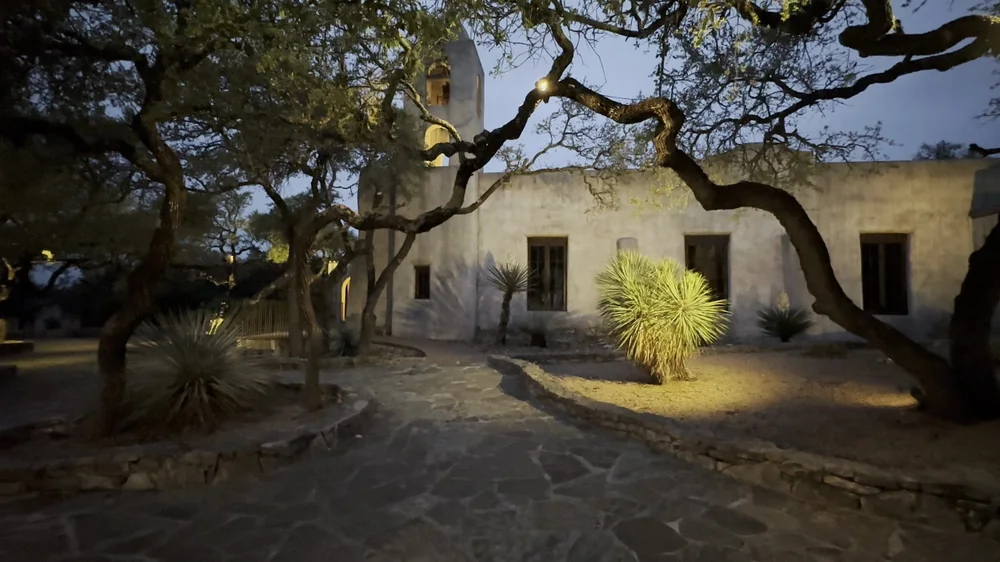
NoonThe Source
NOON SYSTEMS · PBC
SAN ANTONIO, TEXAS
Local Culture
ACEQUIA · 1718
Local Culture · Acequia

Water as culture. The San Antonio acequia.

For two centuries, gravity-fed channels carried the San Antonio River through fields, gardens, and orchards governed by a water boss and cleaned every spring by the people who used it. The engineering was Spanish. The river knowledge was Coahuiltecan. The governance was a commons. What that system did, why it worked, and what residential design still inherits from it.

By Dorian Dégagé · Noon Systems Corporation · San Antonio, TX · ~9 min read

The acequia is not just a ditch. It is a 300-year-old institution that ran through San Antonio from the founding of Mission San Antonio de Valero in 1718 until the early 20th century, and it produced one of the most successful and durable irrigation commons in North America. Calling it "Spanish irrigation" is half right and undersells what it actually was: an engineering system on top of indigenous river knowledge, governed by a set of communal rules that survived three changes of national government.

We write about it here because the design principles — gravity, slow conveyance, multi-use, communal benefit — are still the right principles for residential water in central Texas. We are not reviving the governance. We are noting what the engineering can still teach.

1. What an acequia is.

An acequia is a gravity-fed surface irrigation channel. Water enters from a river or spring at a higher elevation, runs through an unlined or lined ditch following a careful contour, and is released through controlled gates onto fields below. There is no pump. The whole system runs on grade.

The word itself is Arabic. Al-sāqiyah — "the water carrier" — entered Spanish during the centuries of al-Andalus, when Muslim agronomy in southern Iberia formalized irrigation networks that had existed in some form since Roman and pre-Roman times. The Spanish brought the word, the engineering vocabulary, and the governance model to the Americas. In the Southwest — New Mexico, Arizona, and Texas — the system was adapted to a different hydrology: smaller, more variable rivers; karst springs; flash flood regimes. The acequia was not invented in Texas. It was perfected for Texas.

Mechanically it is humble. A diversion dam (a presa) raises river water enough to enter the main channel — the acequia madre, the "mother ditch." Lateral channels (sangrías) branch off to individual fields. Gates open and close each lateral on a schedule. What looks simple is doing a lot at once: conveying, distributing, slowing, percolating, and recharging the shallow aquifer.

2. San Antonio's seven acequias.

Between 1718 and the late 18th century, the upper San Antonio River was tapped by a network of acequias serving the missions, the presidio, and the civilian town. The Texas State Historical Association's Handbook of Texas and Bexar County records document the major channels:

The Espada system is the one to know. According to the National Park Service and the National Register, the Espada Aqueduct — a stone arch carrying the acequia over Piedras Creek, completed by 1745 — is the only Spanish colonial aqueduct still in original operating use in the United States. The Espada acequia madre still delivers river water to land near Mission Espada today. The structure was designated a National Historic Landmark in 1964 and added to the National Register of Historic Places in 1966.

Together, the seven channels turned a stretch of the upper San Antonio River into one of the most productive agricultural systems in North America for nearly two centuries. Corn, beans, squash, sugarcane, peaches, and figs grew on labor lands fed by the acequias. The mission gardens — direct ancestors of any edible landscape in the Hill Country — depended on this water entirely.

3. The mayordomo, the suerte, and the limpia.

The engineering is the half people remember. The governance is the half that made it work for 200 years.

Each acequia was managed by a mayordomo — a water boss, elected or appointed from the users — who held real authority. The mayordomo opened and closed the gates, set the schedule for which user got water on which day, enforced penalties on anyone who took out of turn or wasted, and called the annual cleaning. Below the mayordomo were the users themselves, each holding water shares called suertes. A suerte was a specific allocation — typically expressed as a portion of the channel's flow for a specific number of hours per cycle — attached to a specific parcel of land. In Bexar County records, suertes appear in deeds and water-rights filings well into the 19th century. Water rights could in some cases be transferred separately from the land itself.

Once a year, every user who drew from the channel was required to show up and clean it. This was the limpia — in full, the limpieza y saca de acequia, the "cleaning and clearing of the ditch." Silt was removed, banks were repaired, gates checked. No labor, no water. The institution was self-maintaining because it was self-policing. A user who skipped the limpia or wasted water faced fines from the mayordomo, and persistent offenders could lose their suerte.

This is what scholars like José Antonio Rivera (Acequia Culture: Water, Land, and Community in the Southwest) mean by calling the acequia a commons in the technical sense — collectively governed resource use with clear rules, enforceable penalties, and shared maintenance. The acequia survived because the rules survived. It outlasted Spanish rule, Mexican rule, and the early decades of Texas statehood with the same mayordomo-and-suerte structure in place.

4. The Coahuiltecan foundation underneath.

The Spanish did not arrive at an empty river. The upper San Antonio River and its headwater springs — what we now call the San Antonio Springs and San Pedro Springs — had been inhabited and managed by Coahuiltecan-speaking groups for thousands of years. The Payaya, the Pajalat, and other bands camped at the springs, harvested pecans and prickly pear from the riparian corridor, fished the river, and moved seasonally according to flow.

When Father Antonio de Olivares arrived in 1718, he sited Mission San Antonio de Valero adjacent to existing Payaya settlement at the springs. The Spanish chose locations the Coahuiltecans had already chosen, for the same reasons — clean year-round flow, level ground, defensible terrain. The labor that built the early acequias was largely Coahuiltecan. The standard textbook framing — "Spanish missionaries built the irrigation system" — flattens what actually happened. The acequia was a Spanish technical and legal framework laid over a much older indigenous understanding of the river. Crediting only the friars erases the people whose hands built it and whose ancestors had read the river for millennia.

5. What collapsed the system.

The acequia ran for two centuries. Three things ended it, all between roughly 1880 and 1920.

First, the well. Drilled wells reaching the Edwards Aquifer let individual landowners pull water without participating in any communal channel. A farmer with his own well did not need a mayordomo or a limpia. The commons logic broke.

Second, the pump. Once electric and gasoline pumps were widely available, the gravity advantage that made the acequia efficient became irrelevant. Water could be moved uphill, on demand, to any parcel, regardless of whether it sat on a contour-graded channel.

Third, the municipal main. By the early 20th century San Antonio had a piped municipal water system. Surface channels through downtown were filled, culverted, or paved over. Parcelization of the old labor lands — subdivisions cut across the contiguous irrigated zone the acequia required — broke up the user base the institution depended on. By the 1920s most of the seven acequias were gone in any working sense.

What was lost was not just infrastructure. It was a model of water as a shared resource, allocated by rule rather than by ability to pump. The shift from commons to commodity was convenient. The cost is still being counted — in aquifer drawdown, in flood runoff that used to percolate slowly through unlined channels, in a city that forgot it sits on top of a 300-year irrigation map.

6. What's still here to see.

The Espada acequia and aqueduct are still working. The aqueduct, inside San Antonio Missions National Historical Park, still carries water across Piedras Creek through the same stone arch built in the 1740s. The acequia madre still delivers irrigation to land adjacent to Mission Espada. It is the most direct living link any American city has to its Spanish colonial water history.

The Mission Reach restoration of the San Antonio River, completed in stages through the 2010s, restored ecological flow and riparian planting along the river corridor that once fed the southern acequias. Walking or biking the Mission Reach from downtown to Mission Espada, the historic acequia alignment is visible in places — sometimes as a marked interpretive feature, sometimes as a subtle line in the terrain near the missions themselves.

Remnants survive in central San Antonio neighborhoods too — short culverted segments, place names, a few preserved gates. The San Antonio Conservation Society has long advocated for protection of these fragments; Bexar County archives hold the original water-rights records. SAWS' modern conservation messaging — drought stages, watering schedules, restrictions on waste — is, in a sense, the acequia ethic reissued by a utility. The discipline is the same: water is finite, allocation is by rule, and the rules apply to everyone on the system.

7. What we still build from it.

We do not claim to be reviving the acequia. The institution was tied to a specific land base, a specific agrarian economy, and a specific legal framework that no longer exists. Romanticizing the system as something a homeowner can install in a backyard misses the whole point of what made it work.

But the engineering principles still apply, and they directly inform what Noon designs on residential property in San Antonio and the Hill Country today:

The acequia is a reminder that the smart move in central Texas water has always been to slow it down, spread it out, and use it more than once. That was true in 1718. It is true now. The institutional layer is gone, and that is a real loss. The engineering layer is still available to anyone willing to design with it.

The acequia survived because the rules survived. The engineering was Spanish, the river knowledge was Coahuiltecan, and the governance was a commons. Three centuries of disciplined water on a river running through San Antonio.

Sources

  1. Texas State Historical Association · Handbook of Texas · entries on Acequias, San Antonio Missions, and Spanish colonial water rights · tshaonline.org/handbook
  2. National Park Service · San Antonio Missions National Historical Park — Acequias & Espada Aqueduct · nps.gov/saan
  3. José Antonio Rivera · Acequia Culture: Water, Land, and Community in the Southwest · University of New Mexico Press, 1998
  4. Bexar County Archives · Spanish & Mexican-era water-rights records, suerte filings, and mayordomo registers
  5. San Antonio Conservation Society · Acequia preservation advocacy and historical surveys · saconservation.org
  6. National Register of Historic Places · Espada Aqueduct listing (1966) & National Historic Landmark designation (1964)

Where the published record is thin or varies by source, we say so in the body. Coahuiltecan contributions are credited per current scholarship; pre-1718 indigenous river management is acknowledged as foundational to the system the Spanish formalized.

Common questions.

Can I see a working acequia in San Antonio today?

Yes. The Espada Acequia and Espada Aqueduct south of downtown, inside San Antonio Missions National Historical Park, are still carrying water from the San Antonio River through the original 1731-1745 channel. The acequia madre continues to deliver irrigation to land near Mission Espada. It is the oldest continuously operating Spanish colonial water structure in the United States, designated a National Historic Landmark in 1964 and listed on the National Register in 1966.

Are residential rainwater systems related to acequias?

Conceptually, yes. Both rely on gravity, slow conveyance, and capture-before-loss. A residential cistern paired with overflow into a bioswale is the same logic the missions used at a household scale: catch water where it lands, move it slowly, use it more than once. The governance model is different — modern residential systems are private — but the hydraulic design principles are direct descendants.

Who managed the acequias historically?

A mayordomo — an elected or appointed water boss — was responsible for opening and closing the gates, allocating water turns to each user, enforcing penalties for waste, and organizing the annual cleaning, called the limpia. Water rights, called suertes, were attached to specific parcels and could in some cases be bought or sold separately from the land. After mission secularization in the 1790s, San Antonio city authorities took over distribution; the San Juan acequia later operated as an incorporated mutual company.

Why did the acequia system end?

Late 19th and early 20th century technology — drilled wells, electric pumps, and municipal water mains — made it possible for individual landowners to access water without participating in a commons. Parcelization broke up the contiguous land base the acequias needed to run. By the early 20th century San Antonio had piped municipal water; the surface channels were filled, paved over, or abandoned. Espada is the major working remnant.