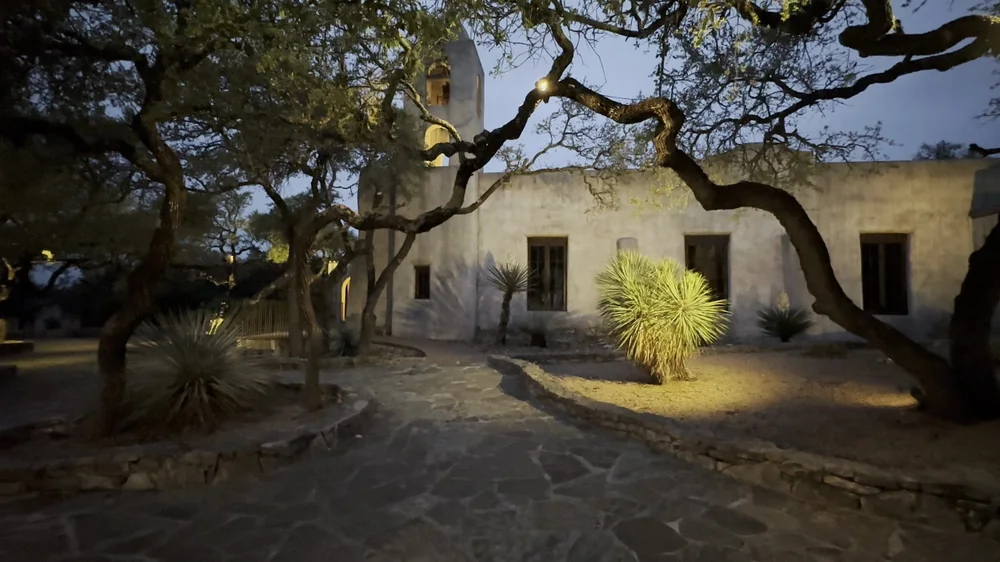
Stand on a Hill Country lot and you are standing on a stacked column. Topsoil — the dark crumbly A-horizon — runs zero to six inches on an undisturbed parcel, and is often missing entirely on a graded development lot where the builder scraped it to the spoil pile and never brought it back. B-horizon clay or loam, the orange-brown subsoil, sits from six to eighteen inches. Caliche — a calcium-carbonate hardpan, pale and chalky, hard enough to dull a shovel — runs roughly twelve to thirty-six inches. Under that, the karst limestone bedrock of the Edwards Group or the older Glen Rose Formation, the same Cretaceous stone visible in every Hill Country roadcut. Four layers. Each one decides something different.
The named soil series under most San Antonio parcels are in the NRCS Web Soil Survey for Bexar County, parcel-by-parcel. Common Hill Country series: Brackett (shallow loam over limestone, the most widespread), Tarrant (very shallow cobbly clay over limestone), Real (clayey over limestone, on the steeper slopes), Eckrant (gravelly clay over hard limestone). On the flatter Blackland-Prairie transition east of the city the column thickens and the smectite-clay percentage climbs — the soil behaves entirely differently, on the same map sheet, three miles apart. The land is not generic. The column under your feet has a name, a depth profile, and a documented engineering record. Most landscape work in this region fails because nobody read it first.
Ecology.
The subsurface decides what grows. Topsoil holds the organic matter, the seed bank, and most of the bacterial and fungal mass. Clay holds moisture and nutrients but locks them up when compacted. Caliche resists root penetration and pushes the pH alkaline. Karst limestone is fractured, cavernous, and conducts water sideways and downward at speed.
This last layer is the one outsiders miss. The Edwards Group limestone is the Edwards Aquifer recharge geology, mapped by the Texas Bureau of Economic Geology and the USGS — fractured karst that takes surface water in fast and stores it in the regional aquifer system that supplies San Antonio's drinking water. The plants that have evolved on this column know it. Ashe juniper, Texas persimmon, cedar elm, agarita, mountain laurel, Lindheimer muhly — the Hill Country palette roots through the thin layers and into limestone fractures. The mycorrhizal network that links them threads the B-horizon and laces into the rock seams. Strip the topsoil, compact the clay, leave the caliche unbroken, and you have killed the ecology before the first plant goes in.
Read the column right, work with it, and the same parcel grows a forest. (More on reading the surface signals that tell you the column underneath.)
Economics.
Landscape and structural failure in San Antonio tracks to subsurface ignorance. Three categories show up over and over.
Foundation movement. Shrink-swell clay is the dominant residential insurance category in this region. Texas A&M AgriLife and Texas Engineering Extension documents rate large parts of Bexar County's clay soils as high to very high shrink-swell potential, with seasonal vertical movement of more than an inch. The cost of a single foundation repair on a typical San Antonio home runs five figures, sometimes six. The triggers are almost all surface decisions: a downspout that dumps under the slab edge, a tree planted too close, a flowerbed that holds irrigation against the perimeter. The clay is going to move. The question is whether the landscape is feeding or starving its swing.
Failed trees. A tree planted in unbroken caliche fails at year three to five. The replacement cost — large-caliper tree plus install plus a second round of irrigation — runs four to six times the cost of doing it once, correctly, with the caliche broken and the planting pocket built right. Multiply across an HOA streetscape and the number gets serious.
Hardscape and drainage failure. A bioswale or dry creek bed designed without reading the subsurface drains where the contractor wanted it to and not where the water actually goes. Patios crack when they're poured over clay that wasn't moisture-conditioned. Retaining walls lean when the footing wasn't keyed to bedrock. Every one of these is a subsurface story dressed up as a surface problem.
Craft.
How Noon reads the column on a site visit.
First, the NRCS Web Soil Survey lookup. Free, parcel-precise, names the soil series and gives the depth-to-bedrock estimate, drainage class, shrink-swell rating, and engineering limitations before we set foot on the ground. That report is the baseline.
Second, the soil probe. A T-handled steel probe pushed straight down until it hits refusal. The depth at refusal is the depth to caliche or rock — usually within an inch of what NRCS predicted, sometimes wildly different where the site has been cut or filled. Five or six probes across the parcel give the real column.
Third, a test hole or two — a hand-dug or augered pit eighteen inches across, dug as deep as the ground allows. The hole shows the layer interfaces directly. We photograph the wall. We feel the clay for plasticity. We look at the caliche for fracture — solid sheet caliche is one problem, nodular caliche another, weathered caliche a third. We pour a bucket of water in and time the drain — under five minutes is permeable, over an hour is functionally impermeable. (Drainage behavior is its own field of study.)
Then the work. Deep ripping on caliche, mechanical or by hand, opens root channels. Gypsum and organic matter on smectite clay reduces shrink-swell over a season or two. Biochar blended into the B-horizon raises cation-exchange capacity and holds the organic amendment in place against the next gully-wash rain. The crew that knows the column knows what to bring. (Field guide to planting in caliche.) (And how compost rebuilds a missing A-horizon.)
Food.
Whether to grow vegetables in-ground or in a raised bed on a Hill Country lot is not an aesthetic call. The column makes the decision.
Root crops — carrots, beets, parsnips, daikon — want twelve or more inches of friable soil, free of rock, with predictable moisture. Most Hill Country parcels give you four to six inches of usable depth above the first refusal layer. In-ground root crops on those parcels fork, stunt, or fail.
The two honest options. Raise the bed — build above the column with a real twelve-to-eighteen-inch soil mix, lined with a broken (not sheet) caliche base so excess moisture can drain. Or break the column — deep-rip, amend with gypsum and compost over a full year, and grow in the ground. Both are documented practice. The deep-bed approach is older than the city: the Spanish mission gardens at Mission San Juan Capistrano and Mission Espada, fed by the acequia system from the San Antonio River, used deep-tilled, manured beds to produce squash, beans, corn, melons, and orchard fruit through the colonial period. The National Park Service maintains a working demonstration farm at Mission San Juan with documentation of the original soil management. The technique works because it respects the column.
Surface crops — leafy greens, herbs, brassicas, tomatoes given enough volume — do fine in the standard four-to-six-inch usable depth if the topsoil is rebuilt. Rebuilding topsoil is the cheapest food infrastructure a Hill Country homeowner can install.
Architecture.
The column under hardscape is the column under everything else.
A patio poured over un-compacted clay will crack within a season as the moisture cycles. A retaining wall founded on caliche held to engineered compaction will outlast the house; the same wall founded on un-keyed soil-over-rock will lean within five years. A dry-creek bed cut to bedrock and lined with the limestone removed from the cut works for decades; the same feature dug into clay without a stone base silts up and breaks. Drainage tile sleeved through a permeable subsurface drains; the same tile run through impermeable clay holds water against the structure it was supposed to protect.
This is the practical knowledge embedded in the regional building tradition. Hill Country limestone construction — the German-Texan stone-walled farmhouses, the mission complexes, the river-bluff retaining walls of downtown San Antonio — was built by people who keyed footings into bedrock because they had no other option. The bedrock was the foundation system. Modern construction has access to engineered alternatives, and uses them poorly. The tradition was correct: build on the rock that is there, and use the dirt above it for what dirt is good for. (More on building from the stone of the place.)
Culture.
The Edwards Plateau's cultural identity rests on its geology. The karst limestone bedrock is what produces the springs. The springs — San Pedro Springs in San Antonio, Comal Springs at New Braunfels, San Marcos Springs at San Marcos — were the indigenous settlement nodes for thousands of years and became the Spanish mission and German colonial settlement nodes for the same reason: water, predictable and abundant, coming up out of the rock. The Texas State Historical Association's Handbook of Texas documents the pattern clearly. Indigenous Coahuiltecan-speaking peoples camped at the head of San Pedro Springs. The Spanish founded the presidio and missions of San Antonio at the same water in 1718. German immigrant settlers in the 1840s located Fredericksburg, New Braunfels, and Boerne at or near similar spring-fed nodes. The caliche-limestone-spring sequence is the geographic substrate of every Hill Country settlement of consequence.
To live here is to live on this stone. The column under the porch is not a soil report. It is the reason the city exists where it does, the reason the water tastes the way it does, the reason the trees are the trees and the food is the food and the wall along the river is built of the same rock that holds the aquifer. Read it right and you are building on three thousand years of pattern. Ignore it and the foundation cracks at year seven.