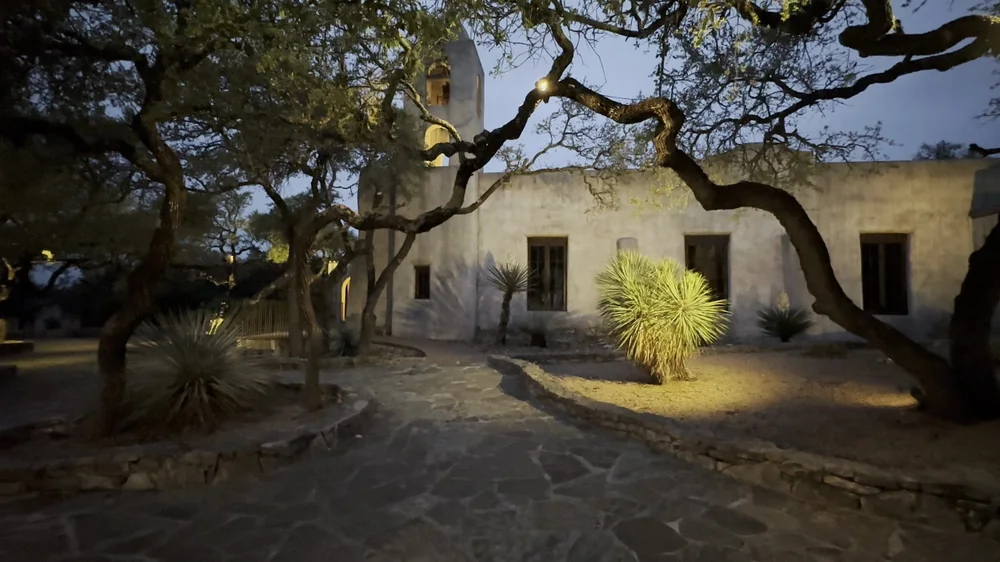
If you've ever swung a shovel in Bulverde, Boerne, or anywhere on the Edwards Plateau and heard a flat metallic tink a foot down, you've met caliche. It's the white-to-cream layer that stops the shovel, breaks the pickaxe handle, and ends the gardening dreams of most people who move out from town expecting a yard. Plant on top of it without understanding it and most of what you put in the ground will be dead by the second August.
Caliche isn't an obstacle to plan around. It's the parent material of the entire region and the reason the native plant palette here is what it is. The job isn't to defeat it. The job is to work with it honestly.
What caliche actually is.
Caliche is calcium carbonate that has precipitated out of soil water over tens of thousands of years and bonded into a layer — sometimes a thin crust, sometimes a shelf eight feet thick. It forms in arid and semi-arid climates wherever rainfall is low enough that water moves down through the soil profile, dissolves calcium from the limestone bedrock, and then evaporates back up before the calcium can flush through. What's left precipitates and cements.
In central Texas, caliche sits over Cretaceous limestone — the same limestone the Hill Country's hills are made of. In a typical Bulverde or Spring Branch lot, you'll find three to twelve inches of thin clay-loam topsoil, then caliche of varying hardness, then the limestone parent rock. On older eroded uplands the topsoil is gone and the caliche is right at the surface. On newer subdivisions developers may have spread six to eighteen inches of "topsoil" over undisturbed caliche, which only delays the problem — it doesn't solve it.
The chemistry: caliche pH runs 7.8 to 8.5. It's high in calcium, magnesium, and iron, but the iron is bound up and unavailable to plants that aren't adapted to alkaline ground. Phosphorus locks up too. Most acid-loving plants from the eastern US — azaleas, blueberries, gardenias, dogwoods, hydrangeas — will yellow out and die in caliche no matter how much you water them. The chemistry isn't negotiable.
Why planting that ignores caliche fails.
Three failure modes, in order of how often we see them:
The bathtub. You dig a planting hole into caliche, hit the hardpan, give up at twelve inches, fill the hole back with bagged topsoil, and put the plant in. For the first season it looks great. Then a heavy rain fills the hole — because the caliche underneath is impermeable, the hole holds water like a clay pot. Roots drown, the plant declines over a few weeks, and the homeowner blames the nursery. The hole was the problem.
The wall. You plant a young tree in a hole that you broke the bottom of but not the sides. The taproot drives down, hits intact caliche on the sides, and the entire root system stays inside the original hole. In year three, when the canopy gets large enough that the small root ball can't supply it through a Texas July, the tree wilts hard, drops half its leaves, and either dies or limps along permanently stunted. We've replaced a lot of these.
The wrong palette. Acid-loving ornamentals planted into corrected, amended, mulched, irrigated caliche soil still chlorose out within two years because the calcium carbonate keeps buffering the pH back up faster than amendments can move it. Sulfur won't fix it (see the FAQ). The plant isn't wrong about what it needs. The site is wrong for the plant.
The Noon method, step by step.
1. Probe before you promise. Before we quote anything, we probe the bed area at five to seven spots with a steel soil probe. We log depth-to-refusal at each. If caliche shows up shallower than six inches across most of the bed, the prep cost goes up — and the client gets told the number before we sign anything. We don't surprise people with caliche bills.
2. Mattock and auger, not shovel. For trees and large shrubs we open the planting hole with a mattock and finish with a one-piece auger on a skid steer where access allows. We break the bottom of the hole at least 12 inches deeper than the root ball requires, and we break the sides — chip the caliche walls so roots have lateral escape. On really tough shelves we drill three or four 36-inch auger holes into the bottom of the planting pit and backfill those with compost mix. Those become drainage and root columns.
3. Amend, don't replace. Imported topsoil alone is the wrong fix. We backfill with a 60/30/10 mix: 60% the native broken-up caliche-and-clay from the hole itself, 30% finished compost (see how we build our own), 10% expanded shale or decomposed granite for permanent porosity. The native fraction matters because we want roots to learn the surrounding soil, not stay inside a pocket of imported fluff.
4. Plant high. Every plant goes in with the top of the root ball one to two inches above grade, then mulched. Caliche sites flood at the surface during big rains and crust over during droughts. Planting high keeps the crown of the plant out of standing water and gives the root flare air. For trees, this is non-negotiable.
5. Water for depth, not frequency. Shallow daily watering keeps roots near the surface, where caliche soil dries fastest and heats hardest. We set new plantings on a deep-soak schedule — heavy water every five to seven days for the first two months, tapering to every ten to fourteen days through the first summer. The point is to drive roots downward into the broken pocket and out through the fissures we opened.
6. Choose a palette that wants to be there. The Edwards Plateau native palette evolved on caliche and limestone. Cedar elm, escarpment live oak, Texas mountain laurel, Texas persimmon, Mexican plum, agarita, kidneywood, autumn sage, blackfoot daisy, four-nerve daisy, gregg's mistflower, big muhly, lindheimer muhly, sideoats grama. None of these need pH correction. None of them need pampering after establishment. They handle alkaline ground because that's the only ground they've ever known.
What holds up.
A planting done this way looks the same on day one as a planting done badly. The difference shows up in year three — when the wrong palette in the wrong holes is half-dead and the right palette in correctly opened holes is reaching the canopy. We've watched both happen on neighboring lots. The work isn't more expensive. It's just done with respect for what the ground actually is.
Caliche isn't the enemy of a beautiful Hill Country landscape. It's the reason a Hill Country landscape looks like the Hill Country. Plant into it honestly and the work will outlive the warranty by decades.
The cultural record of this ground.
The Coahuiltecan bands of South Texas, and later the Spanish mission system around San Antonio, built crops and settlements on top of this same caliche-over-limestone profile for centuries. They didn't bring in foreign topsoil. They worked acequia water through it, planted what already rooted in it — mesquite, prickly pear, agave, native squash and beans — and built the soil up with composted manure and ash. Every Hill Country homestead that has lasted on this ground has done some version of that work. We are not inventing a technique. We are restating an old one in modern terms.