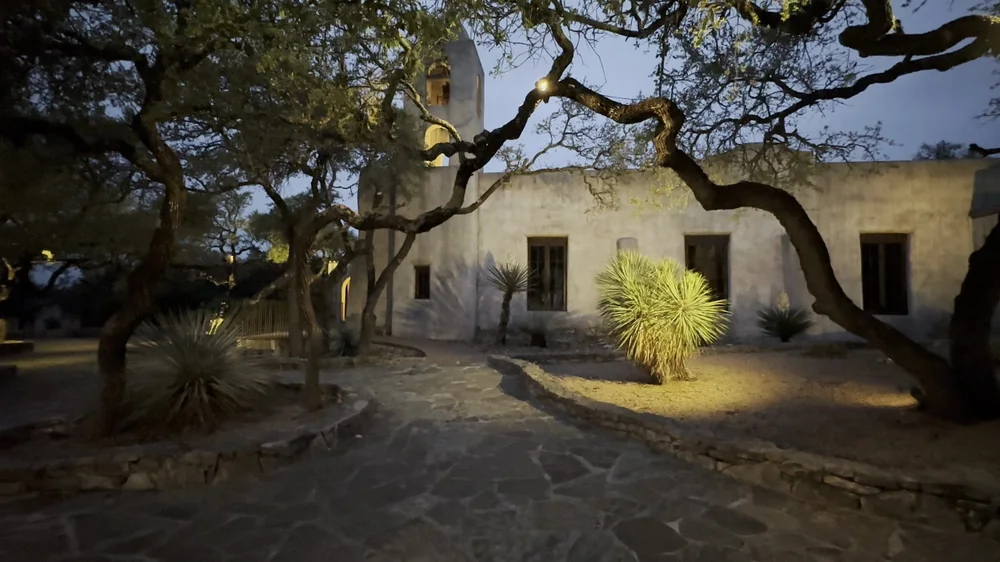
A mature live oak (Quercus fusiformis) on a Hill Country lot carries a canopy with a radius of thirty to fifty feet — call it three to eight thousand square feet of leaf surface working the air. That single tree transpires on the order of forty thousand gallons of water per year, pulled from groundwater and evaporated through stomata in the leaves. The phase change cools the air. Ground temperature under that canopy on a 100°F August afternoon runs ten to fifteen degrees cooler than the unshaded paving twenty feet away. The tree is a chiller, a humidifier, a windbreak, and a habitat stack, all running on sun and soil moisture, all of it free.
Add the other South Texas shade species: post oak (Quercus stellata) on sandy uplands, cedar elm (Ulmus crassifolia) along creek terraces, pecan (Carya illinoinensis) on bottomland, honey mesquite (Prosopis glandulosa) on the dry margins. Together these five species are the working architecture of the region — the fifth reading of the land after slope, soil, water, and aspect. Canopy is not what a property has on top of its infrastructure. Canopy is the infrastructure.
Ecology.
A mature live oak carries a leaf area index (LAI — square meters of leaf per square meter of ground) between five and seven. That stacked surface area intercepts sunlight, lifts water from soil to atmosphere, fixes carbon, and produces oxygen as a byproduct. The same canopy drops several hundred pounds of leaves and twigs per year onto the soil beneath it — slow-release organic matter that builds the duff layer, feeds soil fungi, and recharges the topsoil that the rest of the planting depends on. A landscape without shade trees is a landscape without a soil factory.
The wildlife stack is denser still. Live oaks host hundreds of documented insect associates. Galls on oak branches house solitary native bees. Cavities in old limbs nest screech owls, chickadees, titmice, woodpeckers. Raptors perch in pecan tops to hunt the open ground beneath. Cedar elm and post oak both produce mast crops that feed deer, turkey, and squirrel. Mesquite pods are protein for dozens of bird species and ground mammals. Strip the canopy off a Hill Country lot and the bird count collapses inside a year. Plant the canopy back and it recovers slowly over a decade — but only if the original soil web has not been scraped.
Economics.
USDA Forest Service i-Tree modeling for Bexar County and the broader San Antonio region consistently places the annual ecosystem-service value of a mature shade tree in the range of one to three hundred dollars per tree per year — energy savings, stormwater interception, air quality, and carbon storage combined. Shaded buildings see roughly 15 to 50% reductions in summer AC load depending on canopy placement relative to west and south walls. That is real money pulled off a CPS Energy bill, every summer, for as long as the tree stands.
At the point of sale, mature shade trees consistently appraise at one thousand to ten thousand dollars or more each, per the CTLA / ISA trunk-formula valuation method. Replacement cost is higher than appraisal value — boxing, trucking, and planting a thirty-inch caliper live oak runs well into five figures, and the new tree takes thirty years to do what the original did. The cheapest tree on the property is the one that is already there. The most expensive mistake on a build site is killing it with a bulldozer.
Cross-link the math: a property in the San Antonio native palette with three mature canopy trees and a planted understory may save four hundred dollars a year in summer cooling, intercept tens of thousands of gallons of rainfall before it becomes runoff (see watershed math), and add twenty to forty thousand dollars to the appraisal. The trees are not amenity. They are productive capital.
Craft.
Tree care is a craft. Most of what kills Hill Country shade trees is not drought or pest — it is bad pruning, soil compaction during construction, and impermeable caps within the drip line.
Pruning windows. Texas A&M Forest Service guidance is hard rule: do not prune oaks between February and June. Oak wilt (Bretziella fagacearum) is spread by Nitidulid sap beetles that are most active in spring, and fresh pruning wounds are the entry point. Prune in the heat of summer or the deep cold of winter. Paint every cut — every cut, every season — with wound dressing within minutes of the saw. If a storm tears a limb in March, paint the wound immediately and call an ISA-certified arborist.
Structural shaping. Young trees take shape from early formative pruning. Remove co-dominant leaders, crossing branches, and weak crotch angles in the first five to ten years. After that, prune to maintain — never to "clean up." Topping a shade tree shortens its life by decades.
Root protection. Most of a tree's working roots live in the top eighteen inches of soil and extend out to and past the drip line. Fence the entire drip line during construction. No equipment, no fill, no trenches, no concrete caps. Mulch the root zone three to four inches deep with hardwood mulch (mulch choices for Hill Country) — never volcano-mulched against the trunk.
Food.
Canopy is also pantry. Pecan (the state tree of Texas) is the most obvious — a mature pecan in a good year drops fifty to a hundred pounds of nuts, harvested for centuries on Hill Country farms and ranches. Honey mesquite pods, ground into flour, were a staple carbohydrate across the documented foodways of the Coahuiltecan-speaking peoples whose lands included South Texas (see the full mesquite article); the flour is naturally sweet, gluten-free, and shelf-stable.
Acorns from live oak and post oak were processed by leaching tannins in running water and ground into meal — documented in the ethnobotanical record across many Southwestern peoples. This is presented as historical and educational record, not as a current foraging recommendation; positive species identification and proper tannin removal are non-trivial.
The understory beneath a filtered canopy is its own food layer. Mexican plum (Prunus mexicana) fruits in spring. Wild mustang grape (Vitis mustangensis) climbs cedar elms along creeks. Agarita (Mahonia trifoliolata) yields tart red berries. None of these need full sun. All of them are part of an edible Hill Country landscape built under, not instead of, the shade trees.
Architecture.
The original passive cooling system of South Texas predates air conditioning by centuries. German-Texan settlers in the Hill Country built porches deep on the south and west sides of houses, sited under live oaks where possible, with the canopy doing the heaviest cooling work. The Spanish colonial vernacular went further: thick masonry walls, deep porches, central courtyards with shade trees and a fountain. The trees were architectural.
Where mature canopy does not yet exist — a new build, a cleared lot — the same function can be staged with arbors, ramadas, and vine systems. A galvanized cattle-panel arbor planted with mustang grape or coral honeysuckle gives meaningful shade in three seasons. Lath houses and brush arbors — the German Laubhütte tradition and the Spanish-Mexican ramada tradition — are both Hill Country vernacular for exactly this problem. The arbor is a placeholder for the tree.
Site the porch under the afternoon canopy. Site the bedroom on the east side, under a deciduous shade tree that drops leaves in winter to let the low sun in. Orient the long axis of the house east-west. None of this is new. All of it was forgotten in the 1960s when central air made the climate negotiable, and it is being remembered now that the bill is rising.
Culture.
Every settled landscape has a cultural geography of shade. The plaza tree. The porch oak. The pecan over the front gate. The Spanish-Mexican plaza alameda — named for álamo, the cottonwood — is a town square defined by a planted ring of shade trees, the civic shared cooling commons. San Pedro Park in San Antonio carries that tradition forward. So does the live-oak allée at the missions.
The German Hill Country tradition has its own version: the Laubhütte brush-arbor at harvest festivals, the church grove, the porch oak as the gathering point of a farmstead. Walk Bulverde, Boerne, or Comfort and the oldest houses on the oldest lots are the ones still standing under mature canopy. The tree was not in the way of the house. The tree was the house's site decision.
The cultural loss when a developer clear-cuts a lot before building is not aesthetic. It is the deletion of the property's most expensive piece of working infrastructure, replaced by a turf lawn and a 5-ton AC unit and a utility bill that funds the deletion every month for thirty years. A planted sapling does not put the function back inside a generation. Canopy is built mass. Built mass takes time.