← The Source
Materials & Methods · The Mesoamerican Line

The Mesoamerican line.

A whole sensory world — color that will not fade, walls bound with cactus, red drawn from an insect, stone the color of dried blood — built entirely from the desert's own minerals. It is the oldest design language of this hemisphere, and for a practice rooted in San Antonio it is not a borrowed style. It is an inheritance.

Noon Systems Corporation · San Antonio, TX · ~8 min read

The conquest tried to erase a civilization and missed the walls. The lime stucco that faced the pyramids of the Maya, the pigment still burning on a thousand-year-old mural, the red that funded an empire — all of it came out of the same desert, off the same cactus, from the same ground. Mesoamerica built a sensory world before Europe had a word for the faculty it feeds. Half that lineage is mine by blood, and all of it runs straight through the city I work in. Start with the material.

Cal — lime, and the first chemistry.

It begins, as it does in Rome, with limestone in a fire. Mesoamerican peoples burned limestone to cal for well over a thousand years, and they put it to two uses at once. They soaked corn in lime water — nixtamalization — which softens the kernel into the masa of every tortilla and tamale, and in the same step unlocks nutrition the body otherwise cannot reach. The same lime, slaked and troweled, became the estuco that faced Maya pyramids and whole Mesoamerican cities in a bright mineral skin.

This is the identical lime cycle that built the Pantheon — limestone burned to quicklime, slaked to putty, cured back into stone as it pulls carbon out of the air. Two civilizations, an ocean apart, with no contact, arrived at the same circle. If you want the chemistry in full, it lives in the un-cement. The point here is older and simpler: the foundation of the Mesoamerican palette is the same breathing stone Noon builds with today — and you can source the lime that starts it.

Two civilizations, an ocean apart, with no contact, arrived at the same circle of stone.

Maya blue — the color that would not die.

Then they did something Europe could not. Maya blue is a pigment made by binding indigo — añil, the plant blue — into a rare clay called palygorskite, set with a little gentle heat. The bond it forms is freakishly durable. It shrugged off weathering, acid, and time. It is still vivid on murals like those at Bonampak, and it has been pulled from the offerings and sediment of the Sacred Cenote at Chichén Itzá centuries later — surviving in a tropical climate that rots almost everything else away.

Think about what that means against modern paint. We sell color that fades in a few seasons of Texas sun and call it permanent. The Maya engineered a blue that outlived the civilization that made it. Not by sealing it under plastic — by marrying a plant to a mineral so tightly the two became one stable thing. That is the whole Noon thesis in a single pigment: the most beautiful answer and the most durable answer are the same answer.

Baba de nopal & cochineal — the cactus gives twice.

The nopal — the prickly pear — is the workhorse of this palette, and it gives in two directions at once. Press the pads and you get baba de nopal, a clear mucilage that Mexican builders have stirred into lime washes, plasters, and mortars for generations to improve how the material flows, grips, and sheds water. It was a performance additive centuries before anyone used that phrase, and conservators still reach for it today to restore colonial and heritage buildings. The same trick binds lime on the missions down the road.

On the pads of that same cactus lives an insect, and from it comes cochinealgrana cochinilla — a red so brilliant and so colorfast that it became one of the most valuable exports of New Spain, commonly described as second only to silver, and prized in the courts and on the canvases of Europe. Centered in Oaxaca, it is a living red: a pigment that is grown, not mined. One cactus binds the wall and dyes it. The desert was never poor in color. We just forgot how to ask it.

A pigment that is grown, not mined. The desert was never poor in color — we just forgot how to ask it.

Tezontle & sascab — the stone underneath.

Under the color is the body of the building, and it too came straight out of the ground. In the Valley of Mexico the Aztecs built with tezontle, a red, porous volcanic rock — light enough to lift, strong enough to last — that raised the Templo Mayor and, later, much of colonial Mexico City. In the Yucatán the Maya worked with sascab, a soft, decomposed white limestone the Maya themselves named: a base material for floors and roads, a feedstock for lime and stucco, and the bed of the great white causeways, the sacbeob, that ran between cities.

Red stone and white earth, lime and indigo, cactus blood and cactus glue. Nothing on the list was imported. Every material in the Mesoamerican palette was pulled from the same desert that produced it — which is exactly why it belongs in the same desert today.

Try the foundation

The whole palette starts with lime. The breathing-stone base is three things — hydrated lime, marble dust, a mineral pigment, and a brush. The ratios and safety are in this guide — learn the base on a sample wall, then build toward color.

What this palette does to you.

Walk into a courtyard finished this way and the senses go to work before the mind catches up. A lime wall is cool to the hand. It scatters light into a soft inner glow instead of bouncing it back flat. Color this stable does not read as a coat of paint — it reads as the surface itself, the way the blue at Bonampak still reads. The red is warm and deep and alive. The stone holds the day's heat and gives it back slow. You feel a place built from its own ground as settled, in a way no box of drywall and sealed paint has ever managed.

Five hundred years ago, on the far side of that same ocean, Leonardo kept circling one idea his biographers gather under a single word — Sensazione: that a fuller life runs through continually sharpened senses. The Maya and the Mexica did not need the word. They built it. They made environments that were sensorially alive by default — and modern building did the exact opposite, sealing us into rooms that give the senses almost nothing to work with. Reversing that deficit is the entire reason this company exists.

The Maya did not need the word for it. They built it — a world that was sensorially alive by default.

The line runs through San Antonio.

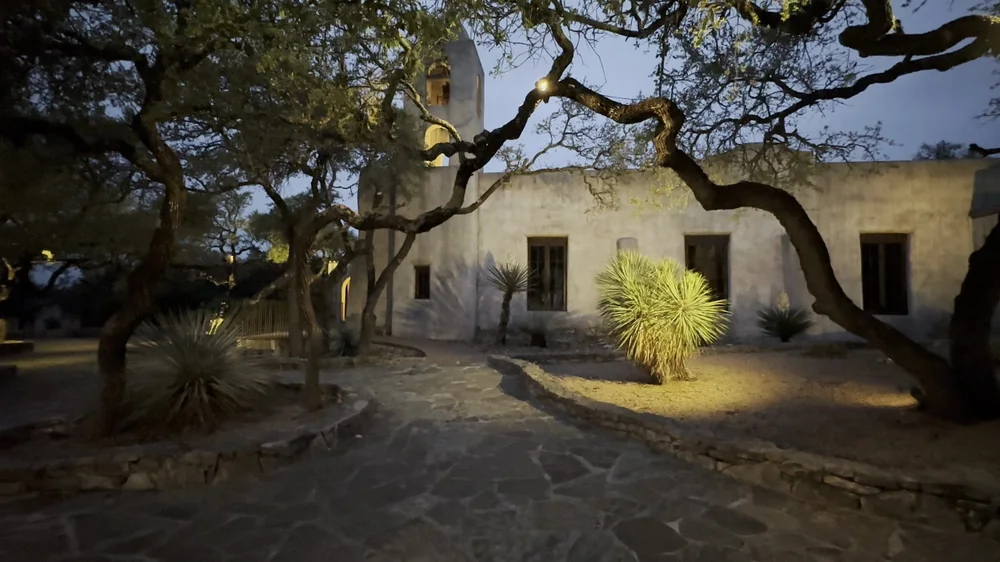
None of this is a museum. The lineage did not stop at the conquest — it bent and kept going, and it runs right through the city I work in. The Spanish missions of San Antonio were raised by Indigenous and mestizo hands in lime and local stone. The acequias that still thread the ground here are a mixed Indigenous-Spanish water craft. The mission gardens carry the same plant-and-mineral knowledge forward. A San Antonio practice working in lime, natural pigment, and cactus-bound plaster is not importing an aesthetic from somewhere else. It is continuing a documented local tradition that never fully went away.

So I will say it plainly. This came up through the people who built Tenochtitlán. It survived the missions and the acequias. It is the design language of this desert and this city both. For me it is also family — the root I come from. Noon does not borrow this palette. Noon inherits it.

Respect the source. Maya blue, cochineal, baba de nopal, and cal are living Indigenous and Mexican knowledge, not a folk motif to costume a wall. Noon names the origin plainly and works the materials as they were meant to be worked. We do not fabricate a "recipe" we cannot stand behind, and we do not flatten a civilization into a color swatch.
Build a courtyard from the desert's own palette.

Start with your hands on the lime that underlies all of it — or have us design and build a San Antonio courtyard in lime, natural pigment, and local stone.