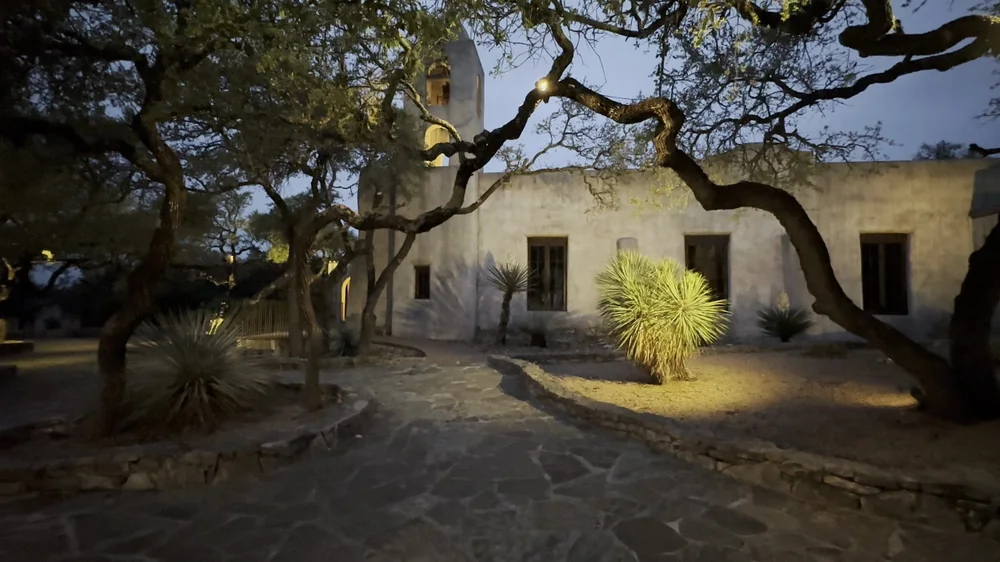
The un-cement.
Lime is the only building material that breathes, heals its own cracks, and pulls carbon back out of the sky as it hardens. We traded it for cement a century and a half ago. It was one of the worst trades in the history of building.
Put your hand on an old mission wall. It is cool, faintly chalky, and alive with a soft depth no roller of latex paint has ever matched. That surface is lime — the oldest finish there is, and the one we mostly abandoned the day plastic paint got cheap. To understand why that was a mistake, you have to follow the material all the way around its circle.
The round-trip.
Lime begins as limestone — calcium carbonate, the same rock San Antonio sits on. Burn it in a kiln and it sheds its carbon dioxide and becomes quicklime. Add water and it slakes, hissing, into a putty. Trowel or brush that putty onto a wall and something happens that no modern binder does: as it cures it pulls carbon dioxide back out of the air and turns, slowly, into limestone again. It ends its life as the same stone it started as.
Chemists call it the lime cycle. It is, in plain terms, the only common building material that returns to where it came from — reabsorbing much of the carbon its own making released. A lime wall is not a coating on a building. It is a slow rock, still setting a hundred years after the mason went home.
A lime wall is not a coating on a building. It is a slow rock, still setting a hundred years after the mason went home.
Why cement is the detour.
Portland cement — patented in 1824, dominant by the twentieth century — won on speed. It sets hard and fast, and for a poured foundation that is exactly what you want. But making it requires roasting limestone and burning fuel to do it, and the result is responsible for roughly 8% of global carbon emissions — more than aviation. Unlike lime, it never meaningfully takes that carbon back.
And it is brittle in the ways that matter for a finish. Cement and the acrylic paints that followed it seal a wall instead of letting it breathe: they trap moisture against masonry, blister in heat-and-humidity swings, and crack without healing. When cement fails, you demolish it. Cement made building fast and disposable. Lime made it slow and close to immortal. For about a hundred and fifty years we have been told the fast, disposable one is "modern." It is simply newer.
Stone that heals itself.
The proof is still standing. The Pantheon's dome in Rome has held, unreinforced, for roughly nineteen centuries — still the largest unreinforced concrete dome on earth. Roman harbor concrete sat in seawater for two thousand years and grew stronger, because the Romans cut their lime with pozzolana, the volcanic ash of the Bay of Naples, which let the material set underwater.
For decades we read the little white flecks in Roman concrete as sloppy mixing. In 2023, researchers at MIT showed it was the opposite of sloppiness: the Romans hot-mixed with quicklime, leaving reactive lime clasts seeded all through the matrix. When a crack opens and water gets in, those clasts dissolve and re-precipitate as fresh calcium carbonate — the concrete heals its own cracks. The flaw was the feature. We spent a century building a material that can only break, while the recipe for one that repairs itself was sitting in the ruins.
Sources: self-healing via hot mixing and reactive lime clasts — Seymour, Masic et al., Science Advances (2023). Roman marine concrete gaining strength in seawater — Jackson et al., on aluminous tobermorite in ROMACONS harbor cores. Portland cement at roughly 8% of global CO₂ — Chatham House, Making Concrete Change (2018).
The line that's yours by blood.
This is not only a European inheritance. On the other side of the ocean, the same chemistry built another world. Mesoamerica burned limestone to cal for a thousand years — for the nixtamal that makes corn into masa, and for the lime stucco that faced the pyramids of the Maya and the temples of Tenochtitlán.
They went further than waterproofing. Maya blue — indigo locked into a rare clay — is a lime-world pigment so stable it is still vivid on jungle murals a thousand years on, in a climate that erases almost everything. Mexican builders toughened and bound their lime with nopal mucilage, the baba de nopal pressed from cactus pads, long before anyone called it an "additive" — and conservators still reach for it to restore colonial walls today. Cochineal red came off the same cactus; tezontle and sascab came out of the same ground. For a practice rooted in San Antonio, half of this lineage is not a borrowed style. It is an inheritance.
What a lime wall does to you.
Here is the part the spec sheets miss, and it is the part Noon is actually about. A lime wall is not only chemically better — it changes the room you stand in. It is cool to the hand. It scatters light instead of bouncing it back flat, which is the quiet inner glow old plaster is known for, deepened by marble dust. It takes the hard edge off sound. It holds and releases humidity so the air in the room stops swinging. You feel all of this before you can name any of it.
Five hundred years ago, Leonardo kept circling one idea his biographers gather under a single word — Sensazione: that a fuller life runs through continually sharpened senses. Modern building did the exact opposite. It sealed us into boxes of drywall, sealed paint, and screens that give the senses almost nothing to work with. That deficit is the whole reason this company exists: built environments now suppress the sensory conditions humans evolved inside, and ecological infrastructure is how you reverse it.
If you want to upgrade a human, stop starting with the human. Start with the room he stands in. That upgrade is two thousand years old.
A lime room is the cheapest way back — not a supplement, not a device, a wall, built from the materials we use. It is also why, on a Noon property reading, a mineral surface moves the Sensorial Choice Score and a painted one does not. The number is just the part you can see.
The return.
So the position is not nostalgia, and it is not a finish option. It is one fact stated twice: the most beautiful way to finish a wall and the most ecological way to finish a wall are the same trowel of the same material. Cement and plastic paint were the detour. Noon is the return.
The whole material is four things — hydrated lime, marble dust, a mineral pigment, and a brush. The ratios and safety are in this guide — mix small and learn it on a sample wall before you commit a courtyard to it.
Be straight about the limits.
Lime is honest, which means it has rules. It bonds to porous mineral substrates, not over latex paint or sealed surfaces. It is not a one-coat finish, and it will not cure right in freezing or bone-dry air. And the working material is caustic.
Try it with your hands on a sample wall — or have us design and apply lime, marmorino, and tadelakt for your courtyard, walls, and fountains.