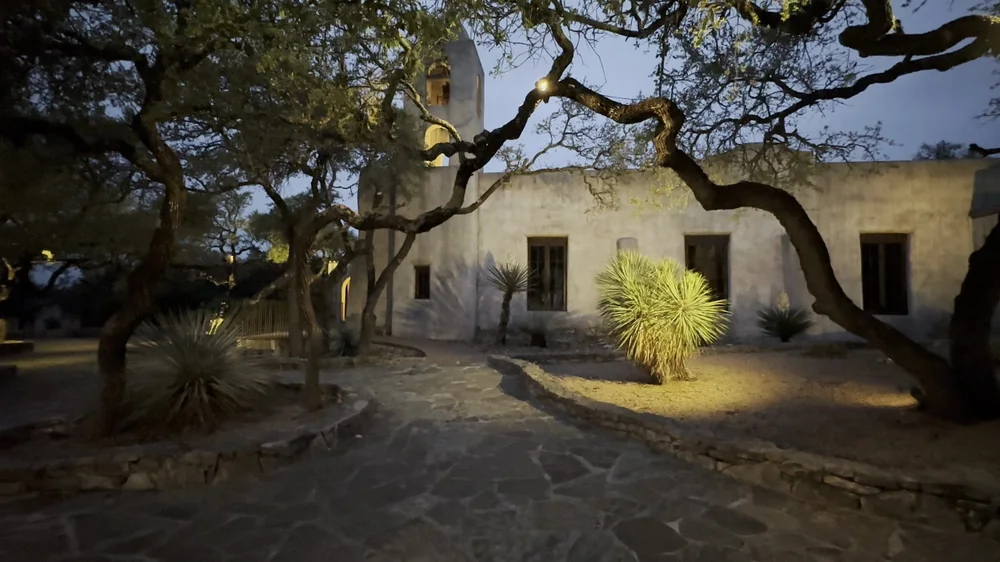
Most landscape advice in San Antonio starts from a blank page. It shouldn't. There is a documented, climatically proven, three-hundred-year-old plant palette already in the ground a few miles south of downtown — at Missions Concepción, San José, San Juan Capistrano, and Espada — and most of those plants will grow on a Hill Country property today with no special care. The historical record did the trial work. The job now is to use it.
This is not a romantic exercise. The mission gardens were not pretty; they were survival. They fed mission communities of several hundred people for over a century under exactly the heat, drought, and thin alkaline soil that defines this region. What survived that filter is what's worth planting now.
1. The mission gardens of San Antonio.
The four southern missions — Concepción (1731), San José (1720, relocated to its current site 1740), San Juan Capistrano (1731), and Espada (1731) — were established along the San Antonio River south of what is now downtown. Each mission was a self-supporting agricultural community. Each was fed by an acequia, the Spanish-engineered gravity-fed irrigation channel that diverted river water across the farmland. The acequia at Mission San Juan still runs today and still irrigates crops.
Mission agriculture had two zones. The labores were the large irrigated field crops outside the mission walls — corn, beans, squash, sugar cane, cotton, chile. The huertas were the walled orchard-and-garden zones closer to the mission compound, where tree crops, vines, vegetables, and herbs were grown more intensively. The Spanish Colonial Demonstration Garden at Mission San Juan, operated by the National Park Service in partnership with the San Antonio Food Bank, reconstructs both zones on the original ground.
This makes the San Antonio missions one of the most thoroughly documented historical garden systems in North America. The plant lists are in mission inventories, traveler accounts, NPS interpretation, and the working demonstration garden itself. If you want a starting palette for this place, it already exists. (For the water-engineering side of this story, see acequias as culture.)
2. The mission palette.
Organized by category, drawn from NPS documentation of Mission San Juan, Spanish colonial mission records, and the working demonstration garden. Plants marked with a botanical name are confirmed in mission-era cultivation; a few are noted with appropriate uncertainty.
Trees. Pomegranate (Punica granatum) — Mediterranean origin, in mission cultivation, still bulletproof here. Fig (Ficus carica) — Mediterranean, in mission cultivation, NPS Mission San Juan plans explicitly cite figs as a resilience crop being replanted. Olive (Olea europaea) — Mediterranean, in Spanish colonial mission cultivation broadly, viable in San Antonio with cold-hardy cultivars. Peach (Prunus persica) — Asian via Mediterranean, NPS lists peach orchards among the mission fruits. Pear (Pyrus communis) — European, in Spanish colonial mission records. Mexican plum (Prunus mexicana) — native to South and Central Texas, in indigenous use, integrated into mission-era plantings. Texas persimmon (Diospyros texana) — native, indigenous food, present on mission grounds. Anaqua (Ehretia anacua) — native shade tree, common on mission landscapes. Pecan (Carya illinoinensis) — native to the river bottoms, a primary food for Coahuiltecan peoples, continued under the missions.
Vines. Grape — both the European wine grape (Vitis vinifera), brought by the Spanish for sacramental and table wine, and the native Mustang grape (Vitis mustangensis), already growing along the river when the missions arrived. Mustang grape is heat-tolerant, disease-resistant, and overwhelmingly vigorous — it is the grape that actually wants to grow here.
Field crops and vegetables. Corn (maize, Zea mays) — Mesoamerican origin, the staple grain. Beans — multiple varieties, Mesoamerican. Squash and pumpkins — Mesoamerican. These three together are the Three Sisters, the indigenous polyculture that predates the missions and that the missions absorbed wholesale. NPS lists corn, beans, squash, pumpkins, sugar cane, potatoes, chile, and cotton as Mission San Juan field crops. The huertas also produced melons, watermelons, cantaloupe (Old World, Spanish-introduced), and chiles in multiple varieties.
Herbs. Spanish colonial garden records across the mission system cite rosemary, oregano, thyme, sage, lavender, mint, cilantro. The specific San Antonio mission herb inventories are thinner than the California mission records, so treat these as the Spanish colonial herb baseline rather than a confirmed San Antonio-specific list. All of them grow easily here today.
Medicinal and utility. Prickly pear (Opuntia engelmannii) — native, primary Coahuiltecan food and medicine, pads (nopales) and fruit (tunas) both eaten, continued under the missions. Agave, yucca, sotol — native, Coahuiltecan staple foods (the cooked crowns), present on and around mission grounds. Cotton was grown in the labores. Indigo is documented in some Spanish colonial mission records as a dye crop, though the San Antonio-specific evidence is lighter; treat it as plausible rather than confirmed.
3. The Mesoamerican layer.
Corn, beans, and squash did not come from Spain. They came from Mexico and ultimately from the long agricultural civilizations of Mesoamerica — Olmec, Maya, Mexica — moving north over centuries. By the time the Spanish arrived, the Three Sisters were already a working system across much of the continent. The missions did not introduce them; they adopted them, because they worked better at this latitude than any European grain.
This is the cultural fusion point that most contemporary accounts miss. The mission garden palette was never a pure European import. It was a hybrid: European tree crops and herbs on top, Mesoamerican field crops in the middle, indigenous South Texas plants underneath. The Spanish brought the orchard. The Aztec-derived agricultural systems brought the staple. The result is what fed the missions for a century.
4. The Coahuiltecan layer.
The Coahuiltecan peoples of South Texas and northern Mexico — the indigenous group whose territory the San Antonio missions occupied and whose members made up most of the mission populations — already had a fully developed food and medicine system before the Spanish arrived. The American Indians in Texas at the Spanish Colonial Missions, a contemporary Coahuiltecan-affiliated organization, documents the foodways in detail.
The Coahuiltecan staples were mesquite bean (ground into flour, baked into cakes — they called the tree árbol de vida, tree of life), prickly pear pads and tunas, agave, sotol, and lechuguilla crowns cooked in pits, pecans from the river bottoms, and a wide game and gathered diet built around what the South Texas brush country actually produces. These were not supplementary to the mission diet. They were what the people inside the missions had been eating for generations, and they continued to eat them under the mission system.
The mission palette as it actually existed on the ground was therefore not Spanish invention. It was a Spanish horticultural overlay on a pre-existing, intricate Coahuiltecan plant-knowledge system. Crediting only the Spanish layer is bad history and worse horticulture.
5. Why it still works.
Three reasons.
First, climate match. The plants in this palette were selected and re-selected over a century-plus of mission cultivation under the exact climate that exists in San Antonio now: 38-inch average annual rainfall, brutal summer heat, occasional hard freezes, alkaline limestone-derived soil. Plants that couldn't take it died early; the survivors are what entered the historical record. That is a longer trial than any commercial breeding program.
Second, soil match. Most of this palette evolved on Mediterranean limestone-derived soils (the European trees) or on similar arid-to-semi-arid landscapes (the Mesoamerican and Coahuiltecan plants). The thin alkaline caliche-over-limestone that defeats most temperate-zone fruit trees is what these plants prefer. (For what to do with caliche specifically, see planting in caliche.)
Third, water match. The mission palette was designed around acequia irrigation — deep, infrequent flood watering rather than daily spray. That matches both the natural rainfall pattern here (long dry spells punctuated by heavy storms) and the kind of low-input residential irrigation that actually holds up. Plant this palette, water it the way the missions did, and the system runs with a tenth of the inputs a turfgrass landscape needs.
6. A residential adaptation.
What we actually put in a Noon install on a half-acre San Antonio or Hill Country property, compressed from the full mission palette to something a homeowner can plant and maintain:
Trees, four picks. One pomegranate — multi-trunk shrub form, anchors a corner, fruits reliably by year three. One fig — single-trunk or multi-trunk, plant where it gets morning sun and afternoon protection. One Texas persimmon — slow, beautiful, native, the silver-barked counterpart to the imported fruits. One Mexican plum for the early spring bloom that breaks the late-winter dormancy and feeds the first pollinators.
Vine, one pick. A Mustang grape on a real trellis or arbor. Don't fight it with European wine grapes unless the client specifically wants table wine — Mustang is what wants to grow here, and it produces a tart fruit that makes a serious jelly and a respectable country wine.
Herb stack. A low evergreen border of rosemary, oregano, thyme, and sage, planted where the cook in the house can reach it from the back door. These four are functionally indestructible in San Antonio if you put them in well-drained soil and don't overwater. (For the broader edible-landscape strategy that wraps these, see edible landscape in the Hill Country.)
Architectural anchor. A clump of Opuntia engelmannii — prickly pear — sited where it can hold a corner or terminate a sightline. Edible pads, edible fruit, zero irrigation after establishment, three-hundred-year cultural lineage. Pair with a single Agave americana or Yucca rostrata if the site can take the scale.
The food line. A short row, six to twelve feet, of Three Sisters: corn, pole beans, squash. Plant after the last frost. This is the one annual element of the install — it teaches the client how a working food system feels on their own property, and it directly references the mission labores. For a broader native-plant context around all of this, see the native palette for San Antonio.
7. What this teaches.
The point of planting from the mission palette is not nostalgia. It is resource literacy. A property owner who plants pomegranate, fig, Mustang grape, prickly pear, and the Three Sisters is not "putting in fruit trees." They are continuing a horticultural tradition that has three centuries of documented success at this exact latitude, on this exact soil, under this exact climate. They are also, whether they intended to or not, honoring the Spanish, Mesoamerican, and Coahuiltecan contributors who built that palette in the first place.
Most modern landscape practice in San Antonio ignores all of this and substitutes a generic nursery palette that was bred for the Atlantic Southeast or coastal California and that fails here within a decade. The mission palette is the corrective. It is the proven, local, culturally documented alternative — and almost every plant in it is still sitting in a nursery a half-hour from your property, waiting to be put in the ground.