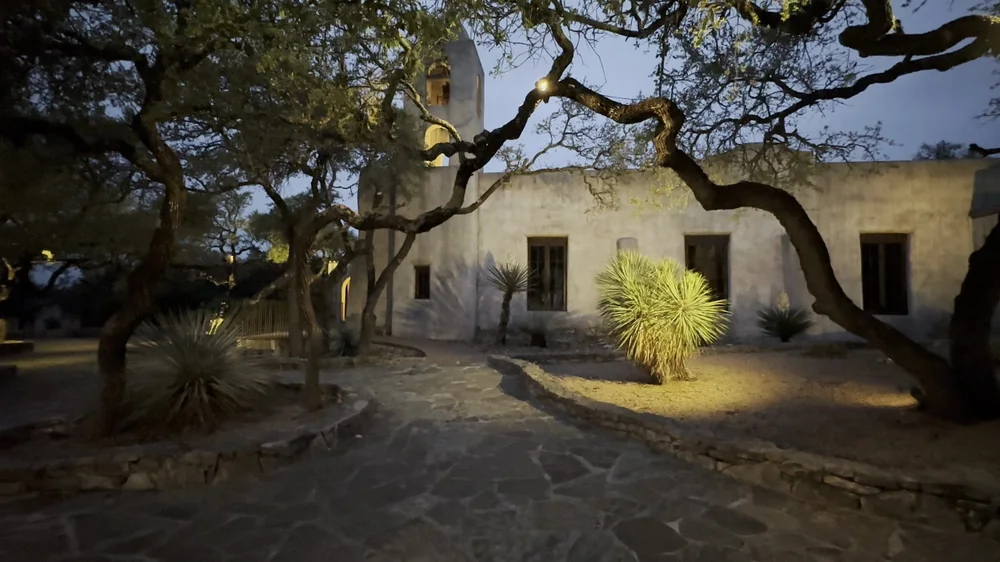
A yucca grows outside the porch and most people see decoration. Spiky. Drought-tough. Vaguely Southwestern. That is the modern reading. The older reading — held in unbroken practice by Apache, Diné (Navajo), Tohono O'odham, and the many Coahuiltecan-speaking peoples whose lands included South Texas — is that the same plant is soap, rope, food, medicine, fire kit, and roof material, in one rosette. The Lady Bird Johnson Wildflower Center and Daniel Moerman's Native American Ethnobotany database both record dozens of distinct documented uses across the genus.
This is a field guide to that older reading, for the three yucca species you are most likely to see in San Antonio and the Hill Country — Yucca rupicola (twistleaf yucca), Yucca pallida (pale-leaf yucca), and Yucca treculeana (Spanish dagger, palma pita) — plus Yucca baccata (banana yucca), the Trans-Pecos species you'll meet if you drive west. Where a use is tribally specific, we say so. Where it is general across the genus, we say that too. Where the record is uncertain, we mark it.
1. Soap.
Yucca roots contain saponins — plant-made surfactants that foam in water and lift dirt and oil the way detergent does. This is not folklore; it is straightforward plant chemistry, and it is the reason yucca root has been the working soap of the arid Southwest for as long as records exist. Moerman's ethnobotany database documents soap and shampoo use across Apache, Diné, Hopi, Zuni, and many other communities. The Diné word tsé'ásts'ózí for narrowleaf yucca translates roughly to "soapweed."
The process is simple. Dig a small lateral root from an established plant — never the central crown. Wash it. Strip the bark. Crush the inner root with a stone or hammer until it is fibrous. Soak the crushed root in warm water and agitate with your hands. A pale, lasting foam comes up within a minute. That foam is the soap.
It still works. It cleans hair without stripping it. It cleans dishes. It is gentler than commercial detergent and leaves a faint vegetal scent. The point is not that you replace your shower with it — the point is that the soap aisle of the supermarket has a wild equivalent growing on your caliche bank, and a person paying attention could go a week without buying any.
Harvest rule, non-negotiable: only small lateral roots from a clump with multiple rosettes, and never more than the plant can regrow in a season. A yucca killed for soap is a yucca that will not feed the white-lined sphinx moth, the yucca moth, or you, next year.
2. Fiber.
Yucca leaves are long parallel bundles of strong cellulose fiber held in a soft green matrix. Remove the matrix and you have rope. Across the Southwest the fiber went into cordage, sandals, baskets, mats, nets, sewing thread, hairbrushes, and paintbrushes. Sandals woven from yucca fiber recovered from dry caves in the region have been dated to several thousand years old — among the oldest preserved footwear in North America. The plant is, in a real sense, a rope farm that grows itself.
Two methods to process. Retting: cut leaves, submerge them in water for one to three weeks until the soft tissue breaks down, then rinse and comb out the fiber. Scraping: pin a fresh leaf flat and pull a dull blade or a smooth stone along its length until only the fibers remain. Scraping is fast and produces clean fiber the same afternoon. Retting is slower but kinder to the fiber and gives you longer working strands.
The finished cordage will hold a knot, take a load, and outlast cotton string. A bundle of yucca fiber rope around the workshop costs nothing and replaces a roll of twine. Yucca treculeana, with its long stiff leaves, gives the most usable fiber per plant of the three local species.
3. Food.
Three edible parts, with real cautions on each.
The flowers are edible across the genus. They are creamy white, mildly sweet, faintly soapy if eaten raw in quantity. Picked young and added to a stir-fry or scrambled with eggs, they taste somewhere between an artichoke heart and a yellow squash blossom. Remove the bitter central pistil. The Lady Bird Johnson Wildflower Center notes that Mexican communities have long eaten yucca flowers — to such an extent that some species rarely set mature seed pods.
The young flower stalk, cut before it blooms, is roasted whole in coals and eaten like a sweet vegetable. This is best documented in Yucca baccata and other large-stalked species. The technique appears across Apache and Tohono O'odham food tradition. Specifics vary by tribe and region — do not assume your grandmother's recipe is anyone else's.
The fruit is where banana yucca, Yucca baccata, earns its name. It produces large, fleshy, banana-shaped pods that ripen in late summer. The Wildflower Center records that "the baked fruit of banana yucca tastes somewhat like sweet potato." Gary Paul Nabhan, ethnobotanist of Southwestern desert food traditions, has written extensively about banana yucca as a stored food across O'odham and Pueblo communities — pulped, dried in cakes, and rehydrated through the winter. Hill Country yuccas mostly do not produce the fleshy fruit; their seed pods are dry. The food story shifts when you drive west.
Caution: never eat any plant part you have not positively identified, and do not eat yucca root, which is the saponin-loaded soap part and will make you sick.
4. Medicine.
What follows is the documented historical record. It is not medical advice and it is not a prescription. Yucca preparations have been used by Southwestern peoples for centuries, but the modern clinical evidence base is thin and saponins are mildly toxic in quantity.
Yucca root contains saponins, which have shown anti-inflammatory activity in laboratory and livestock-feed studies. Topical preparations — crushed-root poultices applied externally — are historically documented for joint pain across multiple Southwestern tribes (Moerman, 1998). Internal preparations such as root teas and decoctions are historically documented for a range of conditions including skin and digestive complaint, with the caution that practice varied widely by tribe, region, and preparer.
The Wildflower Center entry for Yucca treculeana records that Aztec peoples historically used sharpened leaf tips to puncture snakebite wounds and bleed venom. This is included as ethnobotanical record only.
This is documented historical record, not medical or spiritual prescription. Talk to a doctor.
5. Fire.
The dried flower stalk of a yucca is one of the best friction-fire materials in North America. Cured, light, and consistently grained, it serves as the spindle in a bow-drill kit and as the hearth board both. Survival instructors across the Southwest teach yucca-on-yucca as a high-percentage combination — an ember in well under a minute with practiced technique. The root crown of a dead plant, dried, holds a coal for extended carry.
You do not need this skill to live. You need this knowledge to understand that the dead stalk you stepped over last spring was a fire kit. The landscape carries its own infrastructure when you can see it.
6. Ornamental landscape value.
This is where Noon installs yucca, and how. All three local species thrive on caliche — the limestone-derived hardpan that defeats most ornamentals (see our field guide to planting in caliche).
Yucca rupicola (twistleaf yucca) — endemic to the Edwards Plateau. A low rosette, foliage to about two feet, bloom stalk to six feet in summer. Full sun to part shade. Low water, dry preference. The right choice for a hot dry bank or the south-facing edge of a gravel garden. Cold-hardy through Hill Country winters.
Yucca pallida (pale-leaf yucca) — Texas endemic, blue-green broader leaves, tolerates more shade than most yuccas. Foliage stays under thirty inches; bloom stalk to about six feet. The species we reach for under an oak canopy where most yuccas would sulk. Blooms less reliably in deep shade.
Yucca treculeana (Spanish dagger, palma pita) — the South Texas trunk-former. Grows to ten feet or more on a single stem, sculptural, slow. Use it the way an architect uses a column. Stiff sharp leaves — site it where children and bare legs are not.
None of the three need irrigation after establishment. None need fertilizer. All three feed yucca moths, native bees, and — when in bloom — hummingbirds at dusk. They belong in a San Antonio native palette not as filler but as anchor.
7. What this teaches.
The yucca outside the porch is the same plant the people who lived here a thousand years ago used to wash, tie, eat, treat pain, and start fire. None of that ancestral function has gone away. The plant still makes the soap. The fiber is still strong. The flowers still feed people in northern Mexico every spring. The supermarket charges money for the laundered versions of things the land is producing for free, and the only thing in the way is whether we remember.
This is the cross-pollination thesis of an edible, useful Hill Country landscape: every plant we install is also a resource. A yucca is not decoration that happens to be hardy. It is a working pantry, hardware store, and pharmacy that happens to look beautiful at the edge of a gravel path. Reframing it that way changes what the yard is for.
The point is not to live off your landscape. The point is to know that you could.