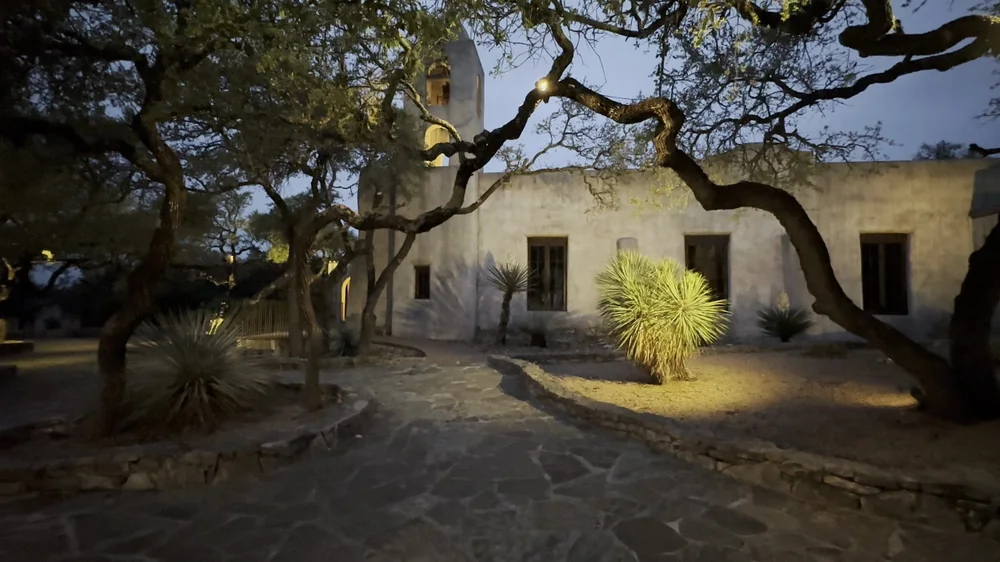
Count the species on your property. A standard suburban lot of turf, foundation shrubs, and a crape myrtle runs five to ten species — a Bermuda or St. Augustine monoculture lawn (one species, sometimes one cultivar), three or four foundation shrubs, two or three trees, a handful of bedding annuals. A Noon-installed native bed on the same lot typically lands at thirty to eighty species across canopy, understory, shrub, perennial, and groundcover layers. A documented Edwards Plateau remnant prairie — per Texas Parks and Wildlife and Native Prairies Association of Texas records — carries more than two hundred vascular plant species per hectare. The Edwards Plateau is one of the most botanically diverse regions in North America.
That count is a resource. Every additional species adds redundancy to the system, depth to the food web, and resilience to the next drought, freeze, pest event, or disease wave. The same logic the Texas grid learned in February 2021 — that systems with no redundancy fail catastrophically when stressed — applies to the planting in front of the house. Diversity is engineered insurance. The species number on the plant list is, in real terms, the property's resilience score.
Ecology.
The ecological case for diversity is precise. Shannon's diversity index measures both how many species are present and how evenly they are distributed; a lawn scores near zero, a remnant prairie scores high. Functional redundancy — multiple species playing the same ecological role — means the system survives the loss of any one species. When emerald ash borer takes the ashes off a monoculture street, the canopy is gone; when it takes the ashes off a mixed street, the canopy thins and recovers. When oak wilt takes the live oaks off a property planted in nothing but live oaks (see shade article), the property is bare; when it takes them off a property planted in live oak, post oak, cedar elm, pecan, and Texas red oak, the property loses one species and keeps the canopy.
Trophic complexity compounds the effect. More plant species supports more insect species supports more bird species supports more soil microbial diversity. The Lady Bird Johnson Wildflower Center and Texas Parks and Wildlife eco-region documentation both identify the Edwards Plateau as a hotspot for endemic species — yucca, salvia, dalea, and dozens of others found nowhere else — because the habitat is structurally diverse: limestone outcrop, oak-juniper woodland, grassland, riparian. Plant a designed property that echoes that structural diversity and the biological diversity follows.
Economics.
Economic resilience tracks biological resilience. The FAO and decades of sustainable agriculture literature make the same point at farm scale: a diversified small farm — multiple crops, multiple livestock species, multiple income streams — weathers price shocks, weather shocks, and disease shocks that destroy specialized monoculture operations. A hedgerow yields nuts, fruit, fiber, fuel, fodder, and windbreak from the same linear footprint that a barbed-wire fence yields only a property line. Mark Shepard's Restoration Agriculture documents the polyculture-farm economic case in detail.
At residential scale the same logic holds. A diverse native planting needs less irrigation, less fertilization, fewer pesticide applications, and fewer replacement plants than a monoculture lawn or a row of identical Bradford pears. The labor cost is front-loaded into design and establishment, then drops off a cliff. The lawn's mowing bill never stops. The math over a ten-year horizon favors diversity by a wide margin, and over a thirty-year horizon it is not close.
Craft.
Designing for diversity is a craft with rules.
Layered planting. Five vertical layers, every designed bed: canopy (shade trees), understory (small flowering trees, large shrubs), shrub (mid-height woody), herbaceous perennial, and groundcover. Each layer fills a different niche, captures a different light level, roots at a different depth, and supports different fauna. A bed planted in only one layer wastes most of the available space.
Companion planting. In food beds, certain combinations perform better than monocultures: the documented Three Sisters polyculture (corn / beans / squash) being the Mesoamerican classic; tomato with basil, carrot with onion, brassica with aromatic herbs in the modern Texas A&M AgriLife companion-planting publications.
Hedgerows. Mixed-species linear plantings along property edges. Six to ten species in fifty feet — native plum, agarita, possumhaw, yaupon, kidneywood, evergreen sumac, mountain laurel — yields windbreak, wildlife corridor, fence-line privacy, mast crop, and seasonal flower for pollinators, all in one ribbon.
Pollinator strips. Dedicated bands of native forbs and grasses through and between turf or bed areas. Salvias, milkweeds, frostweed, gayfeather, native sunflowers — see native palette and drought-tolerant perennials by exposure.
Why a thirty-species bed needs less management than a one-species lawn. Dense layered planting closes the canopy and shades out most weed pressure. Diverse root depths reduce competition. Mixed pest predators self-regulate populations (see beneficials article). The lawn has no allies. The bed has thirty.
Food.
Diversity in food production has a deeper documented record than diversity in ornamental landscape.
The Three Sisters — corn, beans, squash grown together — is the documented Mesoamerican polyculture brought north to the Spanish mission farms of South Texas. Corn gives the bean a pole. The bean fixes nitrogen that feeds the corn and the squash. The squash shades the soil, holds moisture, and suppresses weeds. The system produces more total calories per acre than any of the three crops grown alone, on less water, with no fertilizer. The mission garden record at NPS Mission San Juan documents the polyculture as part of the working farm.
Modern food forests extend the principle to perennial systems. Geoff Lawton's permaculture work and Mark Shepard's Restoration Agriculture both document multi-species, multi-layered edible plantings — chestnut canopy over hazelnut understory over berry shrub over herbaceous over groundcover — that yield staple food on marginal land with minimal input. The Hill Country version substitutes pecan, mesquite (see mesquite article), Mexican plum, agarita, and native herbs. The edible Hill Country landscape is a food forest by another name.
Texas A&M AgriLife publishes the local companion-planting guidance for annual vegetable beds — what works in Bexar County clay, what works in Hill Country caliche, what to put next to what for measurable yield improvement.
Architecture.
Diversity in built ecology is a design move. Pollinator strips integrated through patio edges and along walkway boundaries — not banished to a back corner. Hedgerows as the fence: privacy, windbreak, wildlife corridor, mast crop, and seasonal flower in the same ribbon, replacing a cedar privacy fence that does only one job and rots in ten years.
At the street scale, mixed-species tree plantings — live oak, cedar elm, Texas red oak, Mexican sycamore, Mexican white oak — replace the monoculture rows of Bradford pear and ash that have been catastrophic failure modes elsewhere. Emerald ash borer destroyed a generation of urban canopy in the Midwest because every street was ash. Oak wilt is doing similar damage in Texas neighborhoods planted in nothing but live oak. The architectural response is species diversification at the block scale, not heroic chemical management of a monoculture that will eventually fall anyway.
Culture.
Biological diversity tracks cultural diversity, in landscape as in everything else. The mission garden palette at the San Antonio Missions is the documented synthesis of four streams: Spanish (olive, fig, pomegranate, grape, rosemary), Mediterranean (lavender, oregano, garlic), Mesoamerican (corn, bean, squash, tomato, chile, cacao), and Coahuiltecan (mesquite, agarita, prickly pear, sotol, mustang grape, pecan). The garden was diverse because the people working it came from four food cultures and the climate let all four grow. The NPS Mission San Juan farm interpretation and the American Indians in Texas at the Spanish Colonial Missions (AITSCM) Coahuiltecan Foodways Series document this synthesis.
The cultural impoverishment when landscapes go monocultural is real and visible. The post-1950s suburban lawn — a single grass species, often a sterile cultivar, mowed weekly, irrigated, fertilized, herbicided — replaced the diverse small-farm and dooryard-garden tradition that preceded it. The lawn is the visible symptom of a cultural shift toward homogeneity, control, and chemical input as substitutes for diversity, ecology, and labor. It is also the easiest single thing to reverse on a residential lot.
The current revival runs in parallel streams: heirloom seed banks (Seed Savers Exchange), regional seed projects (Native Seeds/SEARCH in the Southwest), the Native Plant Society of Texas demonstration gardens, the slow re-introduction of mission garden plants into San Antonio residential design. The culture is remembering that a yard with one plant in it is poorer in every measurable way than a yard with sixty. Diversity creates resilience — in ecosystems, in economies, in food systems, in landscapes, and in the cultures that build them.