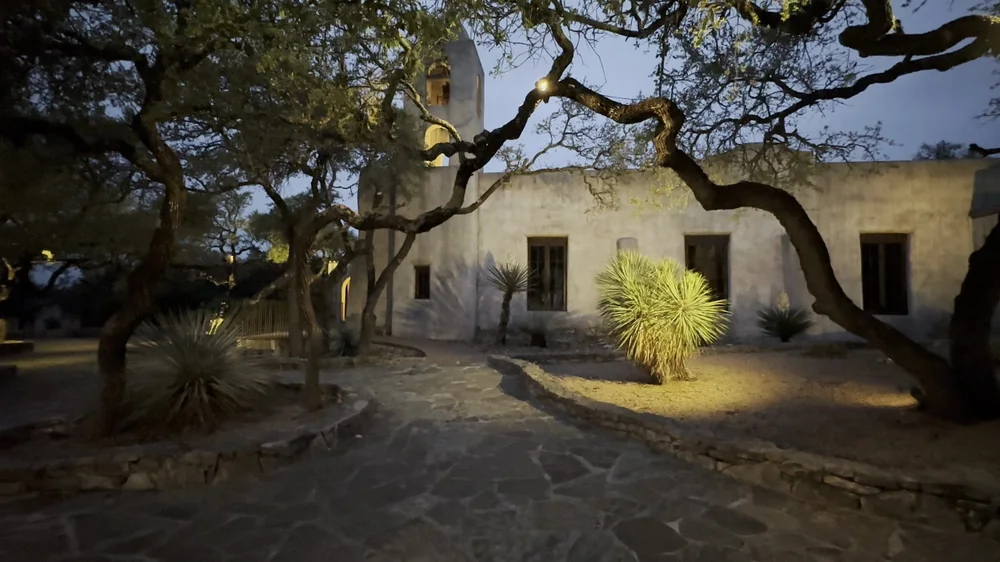
Edwards Limestone is everywhere here. The Cretaceous-age formation that geologists call the Edwards Group underlies the entire Texas Hill Country and Edwards Plateau, runs roughly 300 feet thick where it outcrops in Bexar County, and outcrops continuously from the Balcones Escarpment north and west to the Llano Uplift. It is the pale gray-white stone in every roadcut on US-281 north of Loop 1604. It is the bedrock in every Hill Country creek where the water cuts down to rock. It is the rubble in the courses of the 1718 Mission San Antonio de Valero — the Alamo — and the dressed block in Mission Concepción, Mission San José, Mission San Juan, and Mission Espada. It is the retaining wall of the San Antonio River Walk. It is the dry-stack fence between two ranches outside Comfort. It is the chimney of a Fredericksburg Sunday house and the veneer on a new build in Boerne. The same stone, in continuous use, for three centuries. That is not a coincidence. That is the through-line of a regional culture.
Ecology.
Edwards Limestone produces the ecology above it. Karst dissolution — slow chemical weathering of the limestone by slightly acidic rainwater — opens fractures, sinkholes, and caves, and produces the recharge geology that feeds the Edwards Aquifer and the springs at San Pedro, Comal, and San Marcos. (More on the subsurface column the limestone sits in.) The thin alkaline soils derived from the rock favor a specific plant community, mapped by the Lady Bird Johnson Wildflower Center and Texas Parks & Wildlife as the Edwards Plateau ecoregion: Ashe juniper, Texas persimmon, cedar elm, escarpment live oak, Texas mountain laurel, agarita, kidneywood, prickly pear, Lindheimer muhly, blackfoot daisy.
The endemic golden-cheeked warbler nests almost exclusively in mature Ashe juniper of this region — a federally listed species whose entire range is the same map as the limestone. The plant community is the rock. Strip the rock, replace the soil chemistry, and the community shifts. The Hill Country looks like the Hill Country because of what is underneath it.
Economics.
Limestone has been a building economy here since colonial Spain. The 1718 founding of the presidio and Mission San Antonio de Valero used quarry stone cut from the local outcrop — the San Antonio Conservation Society maintains the documentation. The downstream missions — Concepción (1731), San José (1720, relocated 1740), San Juan (1731), Espada (1731) — were built of the same stone, and the original quarry pits are still visible in places along the mission reach of the river. (NPS San Antonio Missions National Historical Park records the construction sequence.)
The economy continued because the stone never stopped being available. Texas Quarries in Cedar Park, the Sisterdale quarries, and a dozen smaller Hill Country operations have produced dimensional limestone for residential and commercial construction continuously into the present. Hill Country ranch construction defaults to limestone because the haul is short, the supply is predictable, and the stone weathers correctly in this heat-and-freeze climate. Limestone veneer on a new Boerne build is not a stylistic gesture — it is the cheapest stone that arrives on the trailer because it came from twelve miles up the road.
This is the economic logic of a local resource: the right material is the one the freight is cheap on. Hill Country construction is one of the few American building economies where the regional vernacular is still also the cost-rational choice.
Craft.
Three traditions of working the stone are still readable on the ground.
Dry-stack walls. The German-Texan tradition, documented by the Texas State Historical Association's Handbook of Texas in its entries on Fredericksburg, New Braunfels, Boerne, and Comfort. German immigrants of the 1840s and 1850s arrived with stonework in their hands and met a landscape made of stone. The ranch and field walls of the Hill Country — the running courses of broken limestone laid without mortar, stacked at a slight inward batter, capped with the largest flat stones — are the legacy. They were standing when the highway was paved and they are standing now. The technique is honest, slow, and entirely transmissible by eye.
Quarried dressed block. The Mexican-Texan tradition at the missions and along the San Antonio River. Soft fresh limestone cuts with hand tools; it hardens on exposure. The mission walls, the Spanish Governor's Palace (1722, on Military Plaza), and the historic downtown retaining structures along the river were built by quarrying soft stone, working it green, and letting it cure in place. The San Antonio Conservation Society documents the technique in its mission preservation work. The same method, modernized, is still used in restoration along the River Walk.
Modern thin-cut veneer. The contemporary expression: dimensional limestone sawn to two-to-four-inch panels and applied as a structural cladding on stud-and-sheathing wall systems. The supply chain runs from the same Hill Country quarries. The visual effect is continuous with the older traditions when the stone is cut and laid by people who understand the historical pattern, and disastrous when it is cut as squared modular block and laid in a thin-bricked grid that betrays the material.
Food.
The limestone shapes the food and the wine.
Alkaline mineral-rich soils derived from Edwards Limestone favor a specific food palette. The Spanish mission gardens, fed by the acequia system from the San Antonio River, produced fig, pomegranate, grape, peach, quince, and the staple corn-beans-squash trio on these soils. (NPS documentation at Mission San Juan demonstration farm and Mission Espada preserves the record.) The mission palette persists because the soil persists. Fig and pomegranate planted on a Hill Country lot today, on the same limestone-derived ground, thrive with the same low input that carried them through the colonial period.
Hill Country wine country is the larger story. The Fredericksburg AVA and the broader Texas Hill Country AVA — federally designated American Viticultural Areas — cover roughly the same geographic footprint as the Edwards Limestone outcrop. The alkaline calcium-carbonate-rich soils derived from the stone produce the terroir the regional wineries trade on, comparable in soil character to limestone-derived wine regions in southern France and Spain. Tempranillo, Mourvèdre, Sangiovese, and Viognier do disproportionately well here for the same reason they do disproportionately well in the limestone regions of the Mediterranean. The wineries are not marketing the geology, but the geology is the reason the AVA exists.
Food and beverage identity in this region is rooted in the rock. (Mission garden palette field guide.) (Acequia water as cultural infrastructure.)
Architecture.
The visible vernacular of San Antonio and the Hill Country is one stone, used continuously, by everyone who has built here.
The Alamo and the four downstream missions. The Spanish Governor's Palace. The Menger Hotel (1859). The downtown river retaining walls built and rebuilt across two centuries. The Hill Country ranch houses of the German settlement period — single-story limestone-block construction with deep porches and tin roofs, the dominant rural building type from Comfort to Mason. The Fredericksburg Sunday houses — small in-town limestone cottages built by farm families who came in for weekend church and market. The O. Henry House, the Yturri-Edmunds Homestead, the Steves Homestead in King William, and the residential stock of every historic San Antonio neighborhood from La Villita north.
The contemporary line. Lake|Flato Architects, founded in San Antonio in 1984, built an internationally recognized practice on a regional materials discipline that puts Hill Country limestone, weathered steel, mesquite, and cypress at the center of a Modernist composition — buildings that read as continuous with the old missions and the old ranch houses without quoting them. The practice has been published widely (Architectural Record, Dwell, Metropolis) and remains the clearest contemporary demonstration of the principle. The architectural identity of the region is geological. When the stone is in the wall, the building belongs to the place.
Culture.
This is the visible answer to a question that gets asked a lot: why do some places feel like themselves and others feel like everywhere?
The places that feel like themselves are the places where the resource and the culture have not yet been pried apart. San Antonio and the Hill Country feel like themselves because the stone in the wall came out of the ground in the next county, the plants in the yard came out of the same ecoregion, the food on the plate grew on the same soil, and the people who built any of it learned the technique from someone who learned it here. The chain of local resource → local skill → local product → local identity is unbroken. Three centuries of construction, three immigrant traditions, one bedrock.
The places that feel like everywhere are the places where every link in that chain has been replaced by an imported substitute. Stone trucked in from a quarry two states away. A plant palette ordered from a regional grower catalog that ships the same plants to Dallas, Atlanta, and Phoenix. Food from a supply chain that does not know which AVA it is in. Architecture from a pattern book printed in another climate. The result is recognizable: a development that could be anywhere and therefore belongs nowhere.
The revival is already happening. Limestone-revival residential construction is now the default mode for high-end Hill Country homes. Lake|Flato's regional materials practice has been imitated, well and badly, across the state. The Texas Hill Country AVA brands itself on geological terroir. Native-palette landscape is a category for the first time in two generations. (Native palette field guide.) (Planting in caliche.) Every one of these moves is the same move: use what the place produced, and the place will look like itself again.